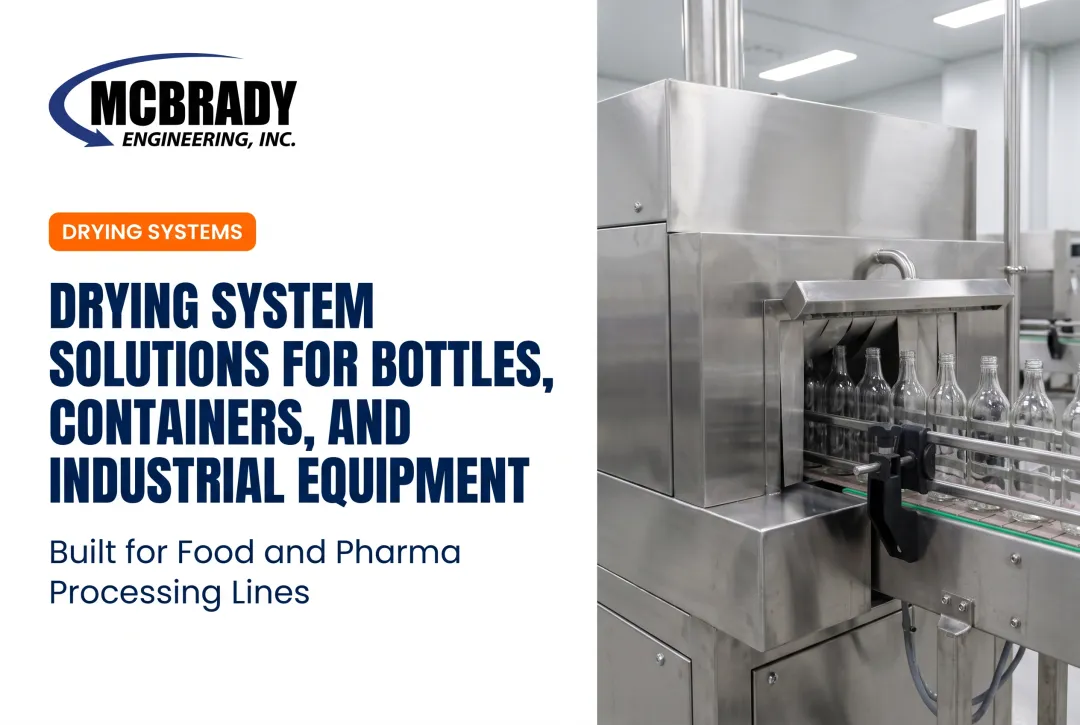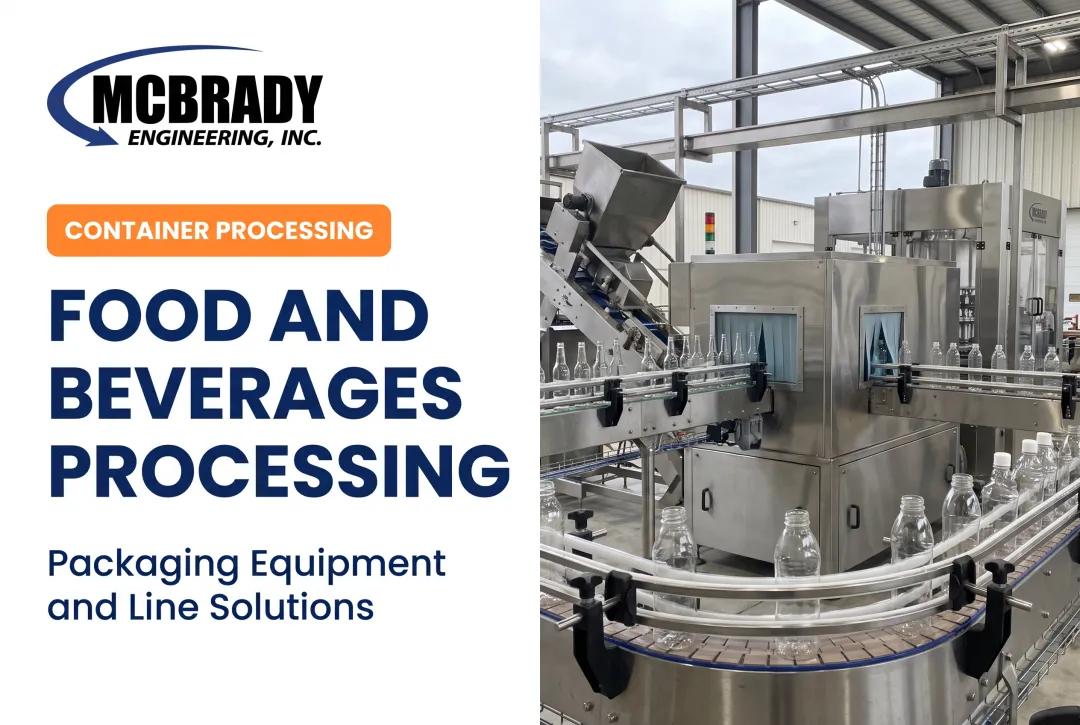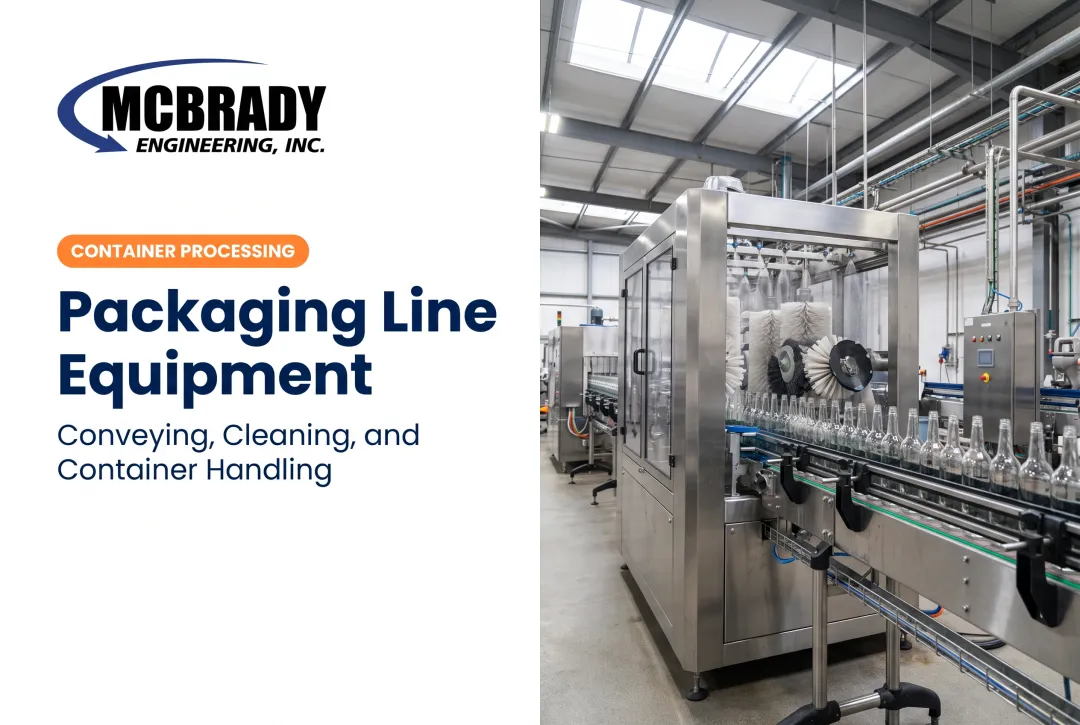

This guide covers industrial can and container surface-drying systems built for beverage and packaging lines. It does not cover household clothes dryers or food-dehydration equipment, which solve a completely different problem.
We'll walk through how these systems work, the main technology types available, what to look for when specifying one, and how drying should be evaluated alongside your existing container-cleaning equipment.
Key Takeaways
- Drying systems remove surface moisture before labeling, coding, inspection, or packing.
- Airflow, container shape, line speed, and downstream requirements all shape the right design.
- Assess drying as part of the full line, not as a standalone machine.
- Hygienic construction, cleaning access, noise, and changeover speed matter at purchase time.
Why Drying Matters on Beverage and Packaging Lines
Containers pick up surface moisture at several points: a rinse tunnel, a bottle washer, filling-related washdown, or a pasteurizer's spray-cooling tunnel. Cold-filled products also sweat as they move into a warmer room. None of that water disappears on its own before the next station.
Labels are often the first casualty. Avery Dennison's technical bulletin on its Z3338 cold/wet adhesive notes that even formulations built for damp surfaces tolerate only limited water. It recommends an air knife near the labeling peel blade, plus a pre-squeegee if condensation keeps returning (Avery Dennison Z3338 technical bulletin).
Moisture creates other problems too:
- Coding and inspection: droplets or condensation can smear inkjet codes or confuse vision systems, driving up false rejects.
- Case packing: wet exteriors weaken carton and case material integrity over time.
- Housekeeping: pooled water around conveyors invites slip hazards and corrosion, depending on plant layout and sanitation schedule.
Not every application needs bone-dry containers. One exception: Domino's beverage fiber-laser coders are documented to mark wet cans without issue, because laser marking does not depend on ink adhesion the way inkjet does (Domino, "Conquering the art of can coding," 2019). That exception is coding-specific. It is not a reason to skip drying before labeling or case packing.
What matters is how dry the container needs to be for the next operation, not how dry you can force it in absolute terms.
How Can Drying Systems Work?
Industrial drying is the controlled removal of surface moisture using airflow, pressure differentials, heat, or some combination of the three. Containers are blasted, blown, or swept clean as they travel the line rather than evaporated dry in a chamber.
The Basic Process
A typical sequence looks like this:
- Stabilize the container on guides or rails so its position is predictable.
- Direct air across wet surfaces using nozzles, knives, or a manifold.
- Carry displaced moisture away from the conveyor path, usually into a collection pan or drain.
- Confirm sufficient dryness for whatever comes next, whether that's a label applicator or a case packer.

Performance depends on more variables than most people expect: air velocity, nozzle position, container geometry, line speed, ambient temperature and humidity, drainage design, and how much liquid is actually present.
Exterior vs. Interior Challenges
Drying a flat can body is straightforward. Rims, necks, seams, shoulders, and recessed label panels are not. These areas trap water in ways a single flat air sheet won't reach, so many systems use angled or multi-position knives aimed specifically at those trouble spots.
Heat isn't an automatic upgrade, either. Added temperature can affect labels, inks, and product inside filled containers, and it raises energy use. Some systems rely on a blower's natural heat of compression rather than a dedicated heater element, a middle ground worth discussing with your supplier before assuming hotter is better.
A quick contrast: a rinsed aluminum can moving at high speed typically needs targeted top-and-side airflow timed to its pass. A larger, irregularly shaped bottle may need adjustable knife angles to handle shoulder contours.
McBrady's Model 41 Exterior Vial Washer/Dryer illustrates a third case: it washes, rinses, and dries filled, capped vials at 150 to 500 vials per minute. A patented zig-zag guide pattern exposes the full exterior while keeping the cap area dry.
Where Drying Fits in the Line
Drying equipment generally sits after a rinse, wash, or washdown step and before labeling, coding, inspection, or case packing. Where exactly it lands affects how well it performs.
Before specifying placement, check:
- Footprint available between upstream and downstream equipment
- Conveyor direction and container spacing feeding into the dryer
- Utilities: compressed air, electrical, or blower capacity on hand
- Access for sanitation and routine maintenance
- Control signals tying the dryer to line speed and reject systems
- Downstream dryness requirement specific to the next operation
Drying performance should be rated against the line's peak speed and worst-case conditions (product changeovers, size changes, and start-up cycles), not just its average run rate.
Types of Can and Container Drying Systems
Several airflow technologies handle exterior drying, each with different strengths.
Air-Knife Systems
Air knives produce a narrow, high-velocity sheet of air that displaces water from the surface it hits. Position, angle, and height are usually adjustable, which matters when you're running multiple container shapes.
EXAIR's own bottle blow-off comparison measured its Super Air Knife using 55 SCFM at 60 psig, with a sound rating of 69 dBA at 80 psig for most applications (EXAIR Super Air Knife blow-off comparison). Figures like these are specific to that tested configuration, not a universal benchmark, but they're a useful reference point when comparing quotes.

Limitations to watch for:
- Noise and air consumption
- Dead zones on complex geometries
- Precise nozzle placement for each new container format
Blower or Centrifugal-Air Systems
Blowers push broader airflow across a conveyor, often with multiple knives covering several container positions at once. Sizing, filtration, and enclosure design all affect how consistently the system performs across a full production run.
Heated-Air and Combined Systems
Some lines add controlled heat when ambient-air drying alone can't keep up with humidity or liquid load. This isn't a default upgrade: it adds energy cost and complexity, and it needs condensation management of its own.
Vacuum-Assisted and Specialized Approaches
Vacuum or specialized air-handling setups occasionally help with hard-to-reach areas, but suitability depends heavily on container shape and throughput. Ask for validated performance data before assuming this fits your application.
| System Type | Mechanism | Best Fit | Trade-Offs |
|---|---|---|---|
| Air knife | High-velocity air sheet | Targeted spots: rims, seams, label zones | Noise, air use, needs precise positioning |
| Blower/centrifugal | Broad distributed airflow | Multi-position coverage on wide conveyors | Larger footprint, filtration upkeep |
| Heated-air | Air sheet plus added heat | High-humidity or heavy liquid load | Energy cost, condensation control |
| Vacuum-assisted | Suction-based removal | Niche, hard-to-reach geometries | Limited validated data, shape-dependent |
How to Select and Specify a Drying System
Start with the container itself, not the equipment catalog.
Container and process profile:
- Material, diameter, height, and shape
- Surface finish, seam, rim, or recess configuration
- Whether containers are empty, filled, capped, or already labeled
Operating requirements:
- Target line speed and container spacing
- Product and water characteristics
- Acceptable residual moisture, tied directly to the downstream step
- Changeover frequency between container formats
Utility and operating comparisons:
- Compressed air versus blower-driven air
- Electrical demand, heat requirements, and noise levels
- Filtration needs and spare-parts availability
Hygienic and maintenance design:
- Stainless or corrosion-resistant construction
- Cleanable surfaces with no water traps
- Protected bearings and motors
- Tool-free or low-tool access where practical
Before you buy, ask suppliers to define their test conditions:
- Test container used for published performance figures
- Liquid load and ambient conditions during testing
- Measurement method for confirming dryness
- Acceptance criteria for a pass/fail result
Request testing across your actual container range, not just a single ideal product. A system that dries 12-ounce cans well may struggle with your 32-ounce bottle.
Factor in installation, utilities, maintenance, downtime, and sanitation time, not just the purchase price, when comparing options.

For projects involving custom engineering, fabrication, or a one-off container-handling arrangement, McBrady Engineering can review your application specifics. Container drawings, line speed, moisture concerns, and downstream requirements all help shape that conversation.
Common Drying-System Problems and Ways to Troubleshoot Them
Even a well-specified dryer can develop issues over time. Here's where to look first:
- Residual water on rims, seams, or label panels: Check container presentation, airflow angle, nozzle position, and whether the knife was ever set up for this specific container shape.
- Inconsistent drying after a changeover: Review guides, spacing, and conveyor speed — many systems need a saved setting or "recipe" per container format.
- Excessive noise or energy use: Look for air leaks, undersized or oversized blowers, blocked filters, or heat running when it isn't needed.
- Water redistributed rather than removed: Inspect conveyor pitch, container rotation, splash containment, and drainage design.
- Moisture reappearing before labeling or packing: Assess condensation, ambient humidity, dwell time, and whether the drying point sits too far upstream from where dryness actually matters.
When troubleshooting, document baseline conditions first and change one variable at a time. That's the only reliable way to separate an equipment limitation from a line, container, or environmental cause.
McBrady Engineering for Custom Container-Cleaning Applications
McBrady Engineering has built compact, efficient interior and exterior bottle-cleaning machinery since 1961, operating out of a 30,000-plus-square-foot facility in Joliet, Illinois. The company's Model 41 Exterior Vial Washer/Dryer and Model 42 Exterior Rinse Tunnel address exterior moisture after rinsing so containers move cleanly into labeling, coding, and packing.
McBrady's custom engineering and fabrication team also supports beverage, pharmaceutical, food, and packaging projects that need a tailored arrangement or a prototype built from scratch. That can include reviewing how container cleaning, rinsing, exterior moisture, and downstream packaging requirements connect on your line, subject to application review.
When you reach out, it helps to have on hand:
- Container drawings or physical samples
- Target line speed
- Current cleaning method
- Specific moisture concerns
- Available footprint and utilities
- Downstream requirements (labeling, coding, inspection, packing)
Contact McBrady Engineering at sales@mcbradyengineering.com or (815) 744-8900 to discuss your application.
Frequently Asked Questions
What are the two types of drying?
The common distinction is natural or ambient-air drying versus mechanically assisted drying. Industrial packaging systems typically use controlled airflow, sometimes adding heat when ambient conditions or liquid load require it.
What is the difference between canning and drying food?
Canning and food dehydration are preservation methods for food itself. Can drying, as covered in this guide, means removing surface moisture from empty or filled containers moving through a packaging line.
What is a drying process?
Drying is the controlled transfer of moisture from a surface into moving air or another medium. Industrial performance depends on airflow, temperature, humidity, exposure time, and the surface geometry involved.
What is a can drying system?
It's equipment that removes water or liquid residue from the exterior of cans as they move through a beverage or packaging line, typically before labeling, coding, inspection, or case packing.
Why do beverage cans need to be dried before labeling?
Excess moisture can reduce label adhesion, interfere with coding or inspection, and create handling or housekeeping issues. The exact dryness level needed depends on the specific downstream process.
How do I choose a drying system for my packaging line?
Evaluate container geometry, liquid load, line speed, required dryness, changeover frequency, utilities, sanitation needs, noise, and footprint. Representative application testing is the best way to confirm fit before committing.