
Introduction
A filling line is only as reliable as the containers feeding into it. Pharmaceutical manufacturers spend heavily on fillers, cappers, and labelers, yet packaging performance often breaks down earlier: in how consistently bottles and vials are presented, cleaned, dried, and transferred before they ever reach the filler.
Multiple container formats, strict contamination-control expectations, tight floor space, and frequent changeovers all complicate that upstream work. PMMI's 2024 contract-packaging research, based on interviews and surveys with 157 manufacturers, found that flexible, fast machinery and strong supplier support rank among the top drivers of equipment investment.
This guide covers pharmaceutical packaging equipment requirements, custom container-cleaning solutions, and what to look for when evaluating a supplier. We'll also show where McBrady Engineering's bottle-cleaning and fabrication capabilities may fit into that picture.
Key Takeaways
- Custom equipment solves format, layout, and line-condition problems standard machinery can't accommodate
- Interior and exterior container cleaning address different contamination risks and often need different mechanisms
- Evaluate suppliers on cleanability, documentation, and integration, not purchase price alone
- Match a manufacturer's capabilities to your specific application rather than general industry claims
Pharmaceutical Equipment Context: Where Packaging and Cleaning Fit
Processing Equipment vs. Packaging-Support Equipment
Pharmaceutical operations typically split into two distinct equipment worlds: core processing equipment that handles formulation and dosage production, and packaging-support equipment that handles everything that happens to the container itself, including preparation, filling-line support, inspection, and final packaging.
FDA's drug manufacturing inspection framework reflects this split directly, identifying separate systems for Production and for Packaging and Labeling, each with its own controls (FDA, 2022). A bottle cleaner belongs firmly in the second category.
The Typical Container Pathway
Containers generally move through a sequence like this before reaching secondary packaging:
- Receiving and orientation - containers arrive in bulk and get unscrambled or oriented for the line
- Interior cleaning - loose particles or residues are removed from the cavity
- Filling and closing - product goes in, caps or stoppers go on
- Exterior cleaning or drying - surface moisture, dust, or handling residue gets addressed
- Labeling and inspection - examination happens at more than one point in the process
- Secondary packaging - cartons, cases, and overwraps that don't contact the dosage form
Note: this is an illustrative sequence, not a fixed regulatory order. The exact pathway depends heavily on your product and container.
Matching Equipment to Your Application
Common equipment categories around pharmaceutical packaging operations include bottle or vial cleaners, air rinsers, drying systems, fillers, cappers, labelers, inspection systems, cartoners, and case packers. The right combination depends on:
- Dosage form and container material
- Opening geometry and neck finish
- Production scale and target line speed
- Cleanliness targets and whether the process is sterile or non-sterile
A supplier's general pharmaceutical-industry experience doesn't automatically mean their equipment fits your specific application. Confirm the match against your actual container and process requirements before assuming compatibility.
Custom Packaging Solutions for Pharmaceutical Operations
Defining "Custom" in This Context
A custom pharmaceutical packaging solution is equipment or a modification designed around your product, container, line layout, or sequence rather than a one-size-fits-all machine. That could mean a modified conveyor interface, an adjustable unscrambler, or a cleaning station built to fit an unusual footprint.
When Customization Earns Its Keep
Standard equipment struggles in several recurring scenarios:
- Unusual bottle or vial dimensions that don't match catalog specifications
- Fragile containers prone to tipping or scuffing on standard conveyance
- Multiple SKUs requiring frequent format changes
- Restricted floor space that rules out standard-footprint machines
- Legacy lines where new equipment must interface with older conveyors or controls
McBrady Engineering's 4-Belt Unscrambler/Single Filer illustrates this kind of flexibility. It's built to nearly any desirable length, can include an L-shaped dump table for manual loading, and can be sold with a McBrady bottle cleaner or separately for integration into an existing line.

What Your Supplier Needs to Know
Before anyone can design a packaging or container-handling solution, they need specifics:
- Container material, dimensions, neck finish, and opening size
- Orientation and weight of the filled container
- Product characteristics and required line speed
- Reject-handling expectations and available utilities
- Washdown conditions and upstream/downstream interfaces
Questions to Ask Before You Buy
A short checklist helps separate genuine customization from relabeled standard equipment:
- What exactly is being customized, and what stays standard?
- How are changeovers performed, and how long do they take?
- What testing is included before shipment?
- What documentation comes with the machine?
- How will future container formats be accommodated?
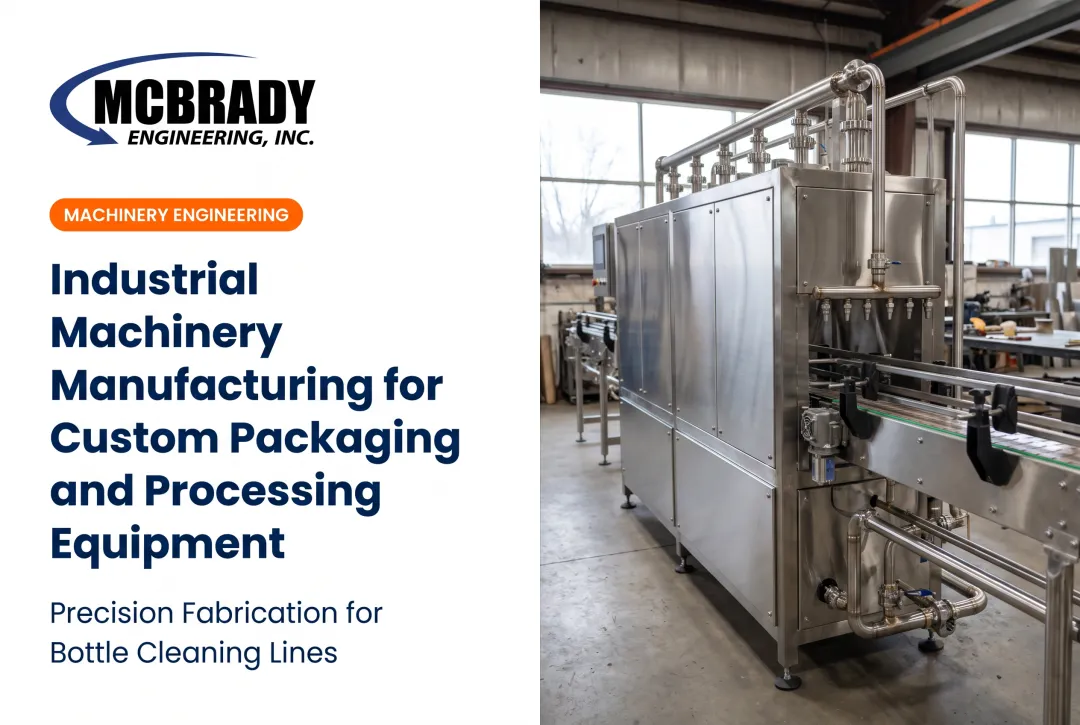
Stable container handling reduces tipping, jams, scuffing, and misalignment that interrupt a line. McBrady's custom engineering and fabrication group builds prototypes and one-off solutions for specialized container-cleaning and packaging-support needs. Confirm exact scope directly with the company for your application.
Pharmaceutical Cleaning Equipment and Applications
Interior Cleaning vs. Exterior Cleaning
Interior and exterior cleaning solve two different problems, and conflating them is a common mistake.
| Cleaning Type | What It Addresses | Typical Timing |
|---|---|---|
| Interior | Loose particles, residues inside the container cavity | Before filling |
| Exterior | Surface moisture, dust, product residue, handling marks | After filling and capping |
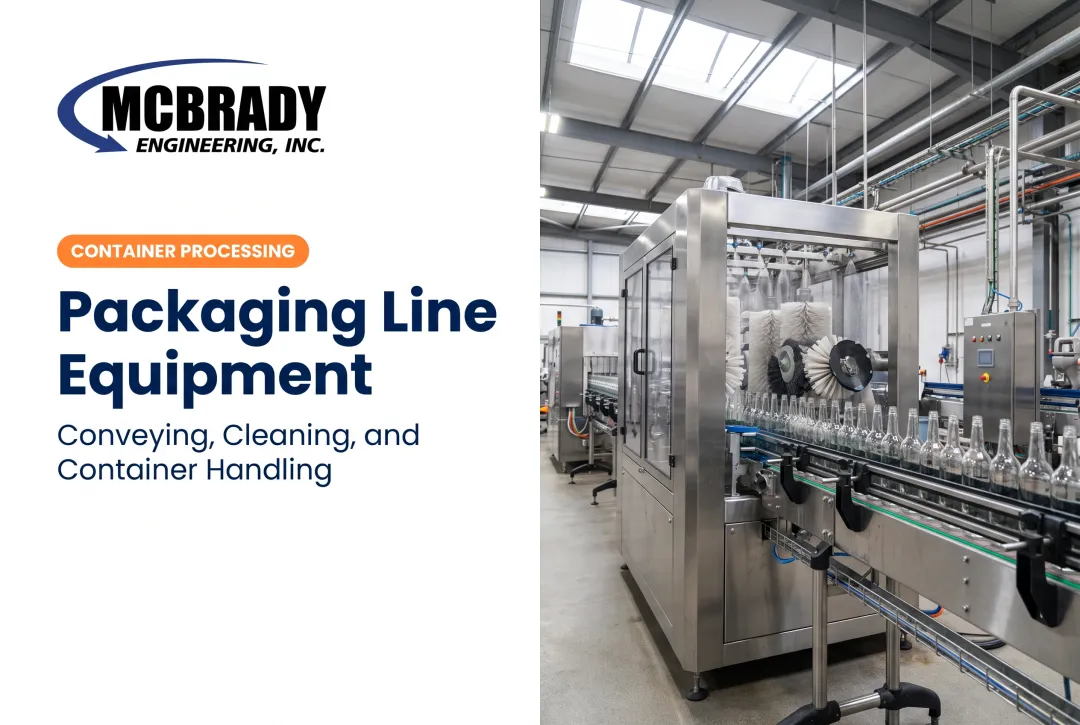
An air rinser, for example, upends empty bottles and blows out particles before liquid filling. An exterior washer/dryer instead washes, rinses, and dries the outside of filled, capped containers, a separate step with separate equipment design.
McBrady's product line reflects this split. The HS-300 Gripper Bottle Cleaner handles interior cleaning and rinsing using a gripper bottle-holding system.
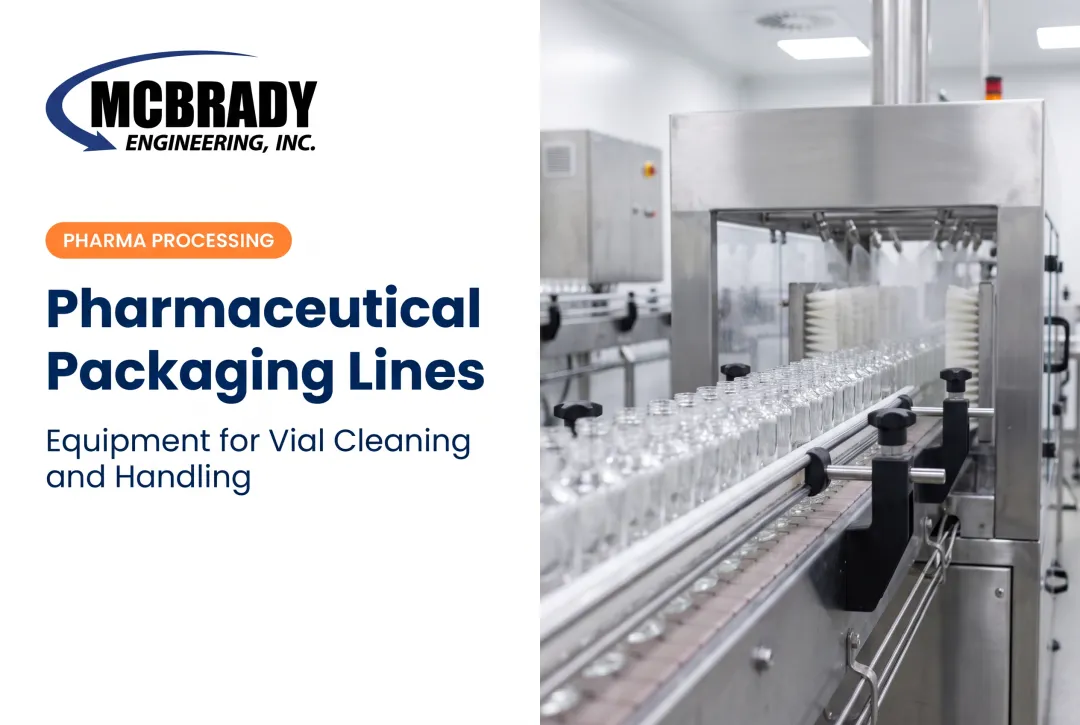
The Model #41 Exterior Vial Washer/Dryer washes, rinses, and dries vial exteriors using a patented "Zig-Zag" guide pattern that exposes the entire surface. It runs at 150 to 500 vials per minute depending on vial size and fits in as little as 8 feet of line space.
Why Cleanliness Can't Be an Afterthought
FDA's regulation on drug product containers and closures requires them to be clean and, where indicated by the nature of the drug, sterilized and processed to remove pyrogenic properties (21 CFR 211.94). That's a conditional requirement, not a blanket claim that applies identically to every container type.
Drying and Moisture Management
Residual moisture after wet cleaning isn't a minor detail. It can affect:
- Label adhesion during the labeling step
- Product compatibility for moisture-sensitive formulations
- Downstream machine reliability
McBrady's Model #41 addresses this with low-pressure washing and rinsing specifically designed to keep the vial cap area dry. That said, a drying cycle alone isn't a sterility guarantee. Microbial control depends on the full validated process, not a single machine function.
Changeover Across Multiple Formats
Operations running several bottle or vial formats need equipment built for repeatable changeovers:
- Format-specific change parts that store easily
- Cleanable contact surfaces
- Documented setup procedures operators can follow consistently
McBrady's Bottle Duster line, for instance, uses tool-less changeovers and reaches speeds up to 400 containers per minute depending on container shape.
For lines that need exterior rinse without a full redesign, the Model #42 Exterior Rinse Tunnel mounts around an existing conveyor in 6', 8', 10', or longer configurations. It keeps contaminants enclosed while rinsing with air, water, sanitizer, or combinations of each.

If you're evaluating cleaning equipment for a pharmaceutical application, confirm the specific model, container range, cleaning method, and documentation available for your project rather than assuming one machine covers every format.
How to Evaluate a Custom Pharmaceutical Equipment Manufacturer
Start With Technical Fit
Before anything else, ask whether the manufacturer has direct experience with:
- Your specific container types and opening geometry
- The cleaning method your application requires
- Your packaging interface and operating environment
- Your throughput needs and required customization level
Check Design and Documentation Support
Reputable suppliers can typically provide equipment drawings, utility requirements, operating instructions, maintenance information, and spare-parts lists. ISPE's commissioning and qualification guidance links verifiable user requirements, risk assessment, and design review to equipment delivery. That gives buyers a framework for the documentation they should expect.
Don't assume a supplier provides specific validation packages unless they've confirmed it in writing.
Evaluate Cleanability and Maintainability
Walk through these access points before purchase:
- Product-contact and exposed surfaces
- Drainage paths
- Inspection points for routine checks
- Change parts and wear components
- Routine service areas
Examine Integration and Controls
A machine that works in isolation but won't talk to your line is a problem. Check:
- Communication with conveyors and line controls
- Sensor compatibility
- Reject handling
- Operator controls
- Safety systems
Also ask how the equipment would accommodate a future container format, since lines rarely stay static for long.

Compare Total Cost of Ownership
Purchase price is only one line item. Factor in:
- Installation and utility requirements
- Labor and cleaning consumables
- Preventive maintenance and spare parts
- Changeover time and expected service life
- Downtime risk if something fails
Verify Support Before You Sign
Confirm these commitments before you sign:
- Installation assistance
- Operator training
- Troubleshooting access
- Replacement-parts availability
- Support response times for US-based operations
Run a Structured RFP Process
Provide prospective suppliers with:
- Representative containers or detailed drawings
- Sample contamination details
- Line-speed targets
- Layout constraints
- Acceptance criteria
This lets manufacturers propose a solution actually scoped to your application, rather than guessing.
Why Work With McBrady Engineering for Custom Cleaning Solutions
McBrady Engineering was founded in 1961 around a single goal: building the best compact interior bottle cleaner possible. That effort produced the Orbit Bottle Cleaner, which became an immediate success and led to an expanding line of interior and exterior bottle-cleaning machinery.
More than 60 years later, the company still operates from Joliet, Illinois, with over 30,000 square feet of manufacturing capability. A few things set the company apart for buyers evaluating container-cleaning equipment:
- Decades of focused experience in bottle and vial cleaning specifically, not pharmaceutical processing broadly
- Compact equipment designs, including machines like the Orbit that mount over an existing conveyor
- Custom fabrication for prototypes and one-off solutions using stainless and mild steel, with pharmaceutical-grade welding available on request
- Delivery of equipment and support across the United States and more than 30 countries
Pharmaceutical and nutraceutical fillers, contract packagers, packaging OEMs, and integrators benefit most from a conversation with McBrady when they face specialized container formats or tight floor space.
If you're working through a container-cleaning challenge, share your container specifications, cleaning objectives, production requirements, and line constraints at sales@mcbradyengineering.com or (815) 744-8900. Every project starts with an application review so the recommendation fits your line.
Conclusion
Packaging and cleaning equipment shouldn't be purchased as isolated machinery. They're part of one integrated container-handling process that starts before filling and continues through secondary packaging.
Keep your buying priorities straightforward:
- Application fit
- Interior and exterior cleaning needs
- Changeover requirements
- Cleanability and documentation
- Line integration and ongoing support
- Total cost of ownership
When standard equipment doesn't fit your container, layout, throughput, or process requirements, custom engineering becomes the practical path forward. If that's where you are, McBrady Engineering can discuss your specific application.
Frequently Asked Questions
What equipment is used in pharmaceutical manufacturing?
Pharmaceutical manufacturing uses processing equipment for formulation, plus filling, cleaning, inspection, packaging, and quality-control systems. The exact equipment list depends on dosage form and facility-specific requirements.
What equipment is typically used in a pharmaceutical lab?
Labs rely on balances, mixers, analytical instruments, and small-scale cleaning or filling equipment for testing and sampling. This differs from production-line machinery, which handles full-scale container processing and packaging.
What is an OEM in pharma?
An OEM, or original equipment manufacturer, designs, builds, and often customizes machinery used by pharmaceutical manufacturers or line integrators. OEMs may also provide documentation and ongoing support for that equipment.
What are CPP and CQA in pharma?
A critical process parameter (CPP) is a process variable that affects product quality and must be monitored or controlled. A critical quality attribute (CQA) is a product characteristic that must stay within an appropriate range to ensure quality, as defined in ICH Q8(R2).
What are the six quality systems in the pharmaceutical industry?
FDA's drug manufacturing inspection model identifies six systems: Quality, Facilities and Equipment, Materials, Production, Packaging and Labeling, and Laboratory Control. These are inspection categories rather than independent product-quality certifications.
What is OEE in the pharmaceutical industry?
Overall Equipment Effectiveness (OEE) measures availability, performance, and quality together to assess how well a machine or line is running. Manufacturers use it to spot losses in packaging or cleaning-line operation, provided the measurement boundary is clearly defined.