
The stakes are real. In a 2025 recall, Sandoz identified vials of cefazolin for injection that had been mislabeled as penicillin G potassium and placed in the wrong cartons. That single case shows how a breakdown anywhere in the handling chain, not just at filling, can put patients at risk.
This guide focuses on primary-container handling: the systems that physically touch the vial, bottle, or ampoule, as distinct from downstream equipment like cartoners and case packers. We'll cover the major system types, how handling works across a line, what to evaluate before buying equipment, compliance basics, and where specialized cleaning machinery fits in.
Key Takeaways
- Vial handling lines typically combine unscramblers, cleaners, fillers, cappers, inspection systems, labelers, and serialization equipment.
- The right system depends on vial material, dimensions, line speed, cleanliness needs, and format changes.
- Interior and exterior cleaning often precedes filling or labeling, depending on your validated process.
- Evaluate equipment as part of the full line, not in isolation, with validation and changeovers in mind.
Types of Pharma Packaging Systems for Vials and Containers
A pharma packaging system is the connected set of machines and controls used to prepare, fill, close, inspect, identify, and protect containers. Primary packaging systems handle the vial or container directly. Secondary and tertiary systems handle cartons, bundles, cases, and shipping units further downstream.
The U.S. Pharmacopeia draws this same line in USP <659>, which defines packaging components by what they contact: primary components touch the drug article directly, while secondary and tertiary layers add protection without necessarily contacting the dosage form itself.
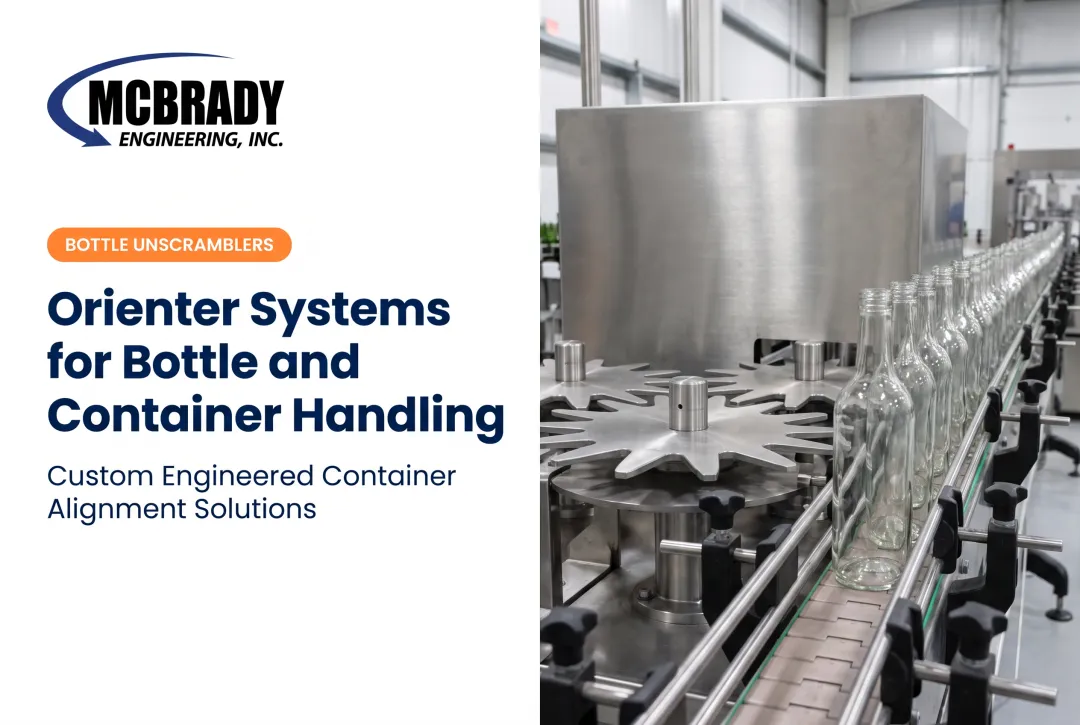
Depalletizing, Unscrambling, and Orientation Systems
Before a vial can be filled, it has to arrive at the right station, facing the right way. Depalletizers, unscramblers, feeders, starwheels, and grippers handle that introduction.
- Unscramblers sort randomly oriented containers into single file. McBrady's 4-Belt Unscrambler/Single Filer, for example, uses three progressively moving belts to separate containers and a fourth reverse belt to prevent jams, eliminating extra transfer points.
- Grippers and starwheels maintain spacing and orientation as containers move between stations.
- Gentle transfer matters most with glass. Poor handling causes tipping, impact chips, scratching, and jams, any of which can take a line down or create rejects.
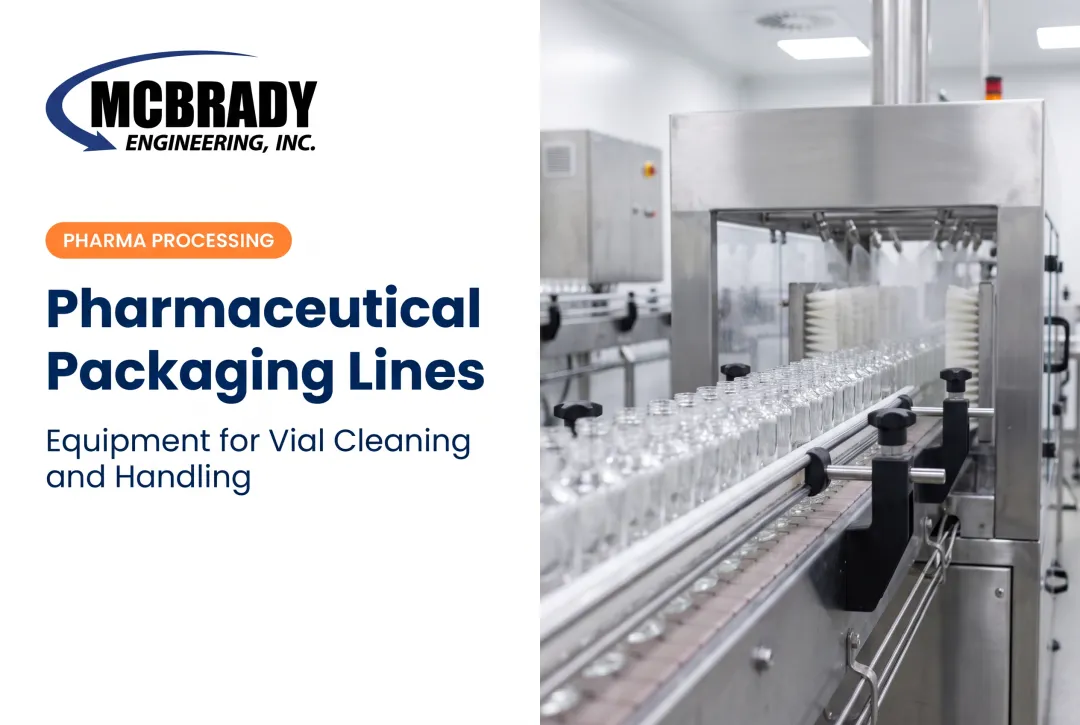
Cleaning, Rinsing, and Drying Systems
Container cleaning covers interior rinsing, exterior washing, and drying. The right method depends on the container, the contamination risk, and the manufacturer's validated process.
Cleaning is not the same as sterilization. FDA's aseptic processing guidance explains that empty glass vials are typically washed and rinsed to remove foreign matter before sterilization and depyrogenation, with dry heat generally used to complete that step. A washer removes residue and particulate. It doesn't, on its own, establish sterility.
In practice, this shows up as separate equipment classes:
- Interior cleaners that rinse residue, dust, or glass fines from inside the container
- Exterior washers and dryers that remove particulate or film from the outside, often after filling and capping
- Drying and filtered air-handling stations that complete the preparation step before the container moves on
Filling, Stoppering, Capping, and Sealing Systems
Filling and closing equipment has to coordinate several things at once: container positioning, fill accuracy, stopper placement, cap application, seal integrity, and line speed. Get one wrong and you get underfills, loose closures, or stalled lines.
Equipment requirements shift considerably by product type:
- Liquid-filled vials generally move through washing, filling, stoppering, and sealing in sequence, sometimes on a single line and sometimes with sealing on a separate machine.
- Powder-filled vials need dosing equipment configured to the specific powder's flow characteristics, not settings borrowed from a liquid filler.
- Lyophilized injectables require partial stoppering before the vial transfers into a freeze dryer, with full seating completed inside the dryer chamber.
Don't assume one machine configuration works across all three. Each has distinct mechanical and validation requirements.
Inspection, Labeling, Serialization, and Secondary Packaging
Downstream of filling, several integrated functions build the quality and traceability record: vision inspection, fill-level checks, closure verification, label inspection, barcode verification, serialization, and cartoning.
Two separate regulatory regimes apply here. FDA's CGMP controls under 21 CFR Part 211 govern packaging and labeling operations generally, including line checks and examination of packaged units. Separately, FDA's DSCSA guidance defines package identifiers for covered prescription drugs as a combination of NDC, serial number, lot, and expiration date, paired with a 2D barcode. Not every container on a line falls under DSCSA, so confirm which rules actually apply to your product before specifying serialization equipment.
How Vial and Container Handling Works Across the Packaging Line
Handling follows a predictable sequence:
- Receiving and staging empty containers
- Depalletizing or unscrambling
- Cleaning or rinsing
- Transfer to filling and closing
- Inspection, labeling, and serialization
- Cartoning, case packing, and final release
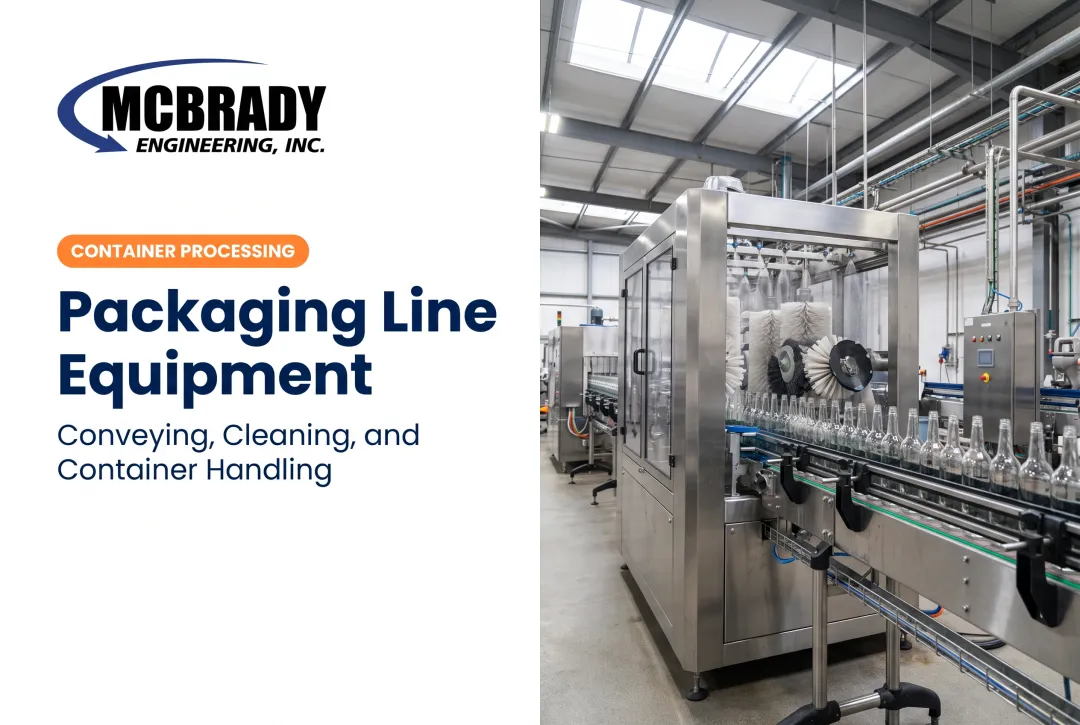
Across those stages, conveyors, guide rails, timing screws, starwheels, grippers, and sensors maintain spacing and orientation at every handoff. If any one of those elements drifts out of sync, the effects ripple downstream fast.
Container Preparation Before Filling
Incoming containers may carry damage, foreign material, dust, residue, or dimensional variation that needs to be caught before filling. Cleaning and drying requirements should come from your process validation and quality risk assessment, not from whatever speed the machine happens to run.
Coordinating Filling and Closing with Container Movement
Inconsistent spacing or unstable transfer causes missed fills, stoppages, stopper-placement errors, cap defects, and product loss. Synchronization between conveyors, fill heads, stoppering stations, and capping equipment is what keeps a line producing good units instead of rework.

Inspection and Rejection Handling
Inspection points vary by product, but commonly include:
- Container presence and position
- Cracks or chips
- Fill level accuracy
- Stopper or cap placement
- Label accuracy and code readability
A controlled reject mechanism matters as much as the detection itself. You need reject confirmation, alarm handling, and documented procedures so flagged units can't slip back into the approved stream.
Changeovers and Multiple Vial Formats
Vial diameter, height, neck finish, closure type, and label dimensions all affect tooling and setup. For contract packagers running multiple SKUs, changeover speed and simplicity matter as much as raw throughput.
Look for:
- Tool-less or simplified changeover features
- Recipe management for repeatable setups
- Setup verification before production resumes
- Documented line clearance procedures
Some equipment classes handle this better than others. McBrady's single-pass washer designs, for instance, require only rail adjustment between vial sizes, with no separate change parts to store or lose.
Data Flow and Line-Level Integration
Programmable controls, sensors, vision systems, batch records, and serialization platforms can exchange data across a line. Whether you need that level of integration depends on your product, facility, and market, not on what's technically available. Treat digital integration as a requirement to evaluate case by case, not a default feature to buy.
How to Choose and Integrate a Pharma Packaging System
Start with a documented specification, not a vendor catalog. At minimum, define:
- Vial or container material and dimensions
- Neck finish and closure type
- Product type and cleanliness requirements
- Throughput and allowable reject rate
- Room classification
- Packaging configuration
Share representative containers, closures, and process samples with your equipment supplier before finalizing a system. A supplier reviewing your actual line layout and operating conditions catches mismatches a spec sheet alone won't reveal.
Throughput, Flexibility, and Format Requirements
Compare your required production rate against a system's sustainable operating rate, not its advertised maximum. A nameplate speed tells you little about performance across your specific vial formats and fill volumes. SKU count, batch sizes, and future capacity plans should drive the choice between dedicated, modular, and highly automated equipment.
Cleanability, Materials, and Maintenance
Hygienic design covers more than the obvious surfaces. Review:
- Accessible, cleanable components and drainage
- Product-contact materials and corrosion resistance
- Washdown tolerance
- Spare parts availability and preventive maintenance needs
- Operator access for routine cleaning
Material compatibility should be confirmed with your quality, engineering, and validation teams for your specific application, not assumed from a generic spec sheet. Equipment built in 304 or 316L stainless steel, for example, holds up differently depending on your washdown chemistry and product residues.
Integration, Validation, and Documentation
Factory acceptance testing, site acceptance testing, installation qualification, and operational qualification all generate documentation you'll need later. Before signing off on a system, clarify:
- Which validation deliverables the equipment manufacturer supplies
- Which remain your responsibility or your integrator's
- Where user requirement specifications and functional specifications fit into the handoff
Gaps here tend to surface during an audit, not during commissioning.

Safety, Serviceability, and Total Cost of Ownership
Guarding, interlocks, ergonomic loading, and cleaning access affect daily operation more than most buyers expect going in. So do training, remote support, and local service availability when something breaks at 2 a.m.
Compare lifecycle cost and line availability, not just the purchase price. A cheaper machine that needs frequent change parts or unavailable service support often costs more over three years than a slightly pricier one that doesn't.
Custom Engineering and Line Integration
Standard machines fall short for unusual vial dimensions, tight floor space, specialized cleaning needs, or integration into an existing legacy line. Custom engineering and fabrication can solve these one-off challenges, but confirm scope, testing, and documentation responsibilities before committing to a supplier.
Compliance, Automation, and Quality Considerations
U.S. pharmaceutical packaging systems need to support your quality system and current regulatory obligations around equipment, production, labeling, records, and traceability. That means checking current FDA regulations, FDA guidance, and applicable USP chapters directly rather than relying on secondhand summaries, including this one, for your compliance decisions.
Automation helps, but it doesn't replace oversight. It reduces repetitive manual handling, improves repeatability, and captures process data automatically. It still requires trained personnel and documented review.
Where barcode verification, electronic records, and audit trails apply to your line, they should align with your specific architecture rather than a generic checklist. Inspection and automation systems also need validation for their intended use:
- Defined detection capability for the intended defect set
- Challenge samples that prove the system catches failures
- Reject verification so bad units leave the line
- Alarm management and documented deviation procedures
Resource use belongs in the same quality conversation. Equipment choices can cut damaged containers and unnecessary rinse-media or compressed-air use, but quantified savings claims need line-specific data. Don't accept a vendor's percentage claim without seeing the underlying numbers.
Where Bottle-Cleaning Equipment Fits in a Pharma Packaging System
Interior and exterior cleaning equipment typically functions as a container-preparation module within a larger pharma packaging line, not a standalone solution. It gets vials ready for filling, labeling, or other downstream handling when your process calls for it.
This is where McBrady Engineering's work concentrates. We build compact interior and exterior bottle-cleaning machinery, with more than 60 years in the field and custom engineering and fabrication for specialized applications.
Our Exterior Vial Washer/Dryer washes, rinses, and dries filled and capped vials or ampoules at 150 to 500 vials per minute. A low-pressure wash and rinse keeps the cap area dry.

McBrady provides cleaning, rinsing, and drying equipment and related custom fabrication. We don't supply filling, stoppering, capping, serialization, or turnkey pharmaceutical lines.
If you're evaluating a cleaning module for your line, come prepared to share:
- Container dimensions and material
- Contamination profile and cleaning objective
- Required line speed
- Drying requirements and room conditions
- Changeover needs across formats
- Integration constraints with existing equipment
If your vial or container-cleaning application doesn't fit a standard machine, our engineering team can also scope a custom solution, from prototype through fabrication. Reach out to McBrady Engineering to talk through your container-cleaning or custom-engineering needs.
Frequently Asked Questions
What are the types of pharma packaging systems?
Pharma packaging systems span primary, secondary, and tertiary packaging, plus functional categories like container cleaning, filling and closing, inspection, labeling, serialization, cartoning, and case packing.
What does a pharmaceutical packer do?
A pharmaceutical packer prepares, fills, closes, labels, inspects, and packages medicines or containers according to approved procedures, product specifications, and quality requirements.
What equipment is used for vial handling?
Common equipment includes depalletizers, unscramblers, conveyors, cleaners or rinsers, starwheels, fillers, stoppering and capping machines, vision inspection systems, labelers, and cartoners.
How do pharmaceutical packaging systems protect vial integrity?
Controlled transfer, gentle handling, validated cleaning, closure verification, and inspection all work together to catch and reject damaged or nonconforming units before they reach patients.
What should manufacturers consider when choosing a vial handling system?
Key factors include vial dimensions and material, product and cleanliness requirements, throughput, changeover needs, line integration, validation documentation, maintenance, operator safety, and future scalability.