
Introduction
A new product line arrives with an odd-shaped bottle. Or a legacy conveyor needs a rinsing station squeezed into eight feet of floor space. Standard catalog machinery doesn't fit, and the production team is stuck.
This is where custom manufacturing comes in. Instead of shipping a catalog machine as-is, a manufacturer designs, fabricates, modifies, or assembles equipment around your line, container, and plant constraints.
Custom work isn't reserved for exotic applications. It covers everything from a modified standard rinser to a one-off prototype built for a single production problem.
This article walks through when custom machinery makes sense, how a project moves from first conversation to installed equipment, and what you should bring when evaluating a manufacturing partner.
Key Takeaways
- Custom manufacturing covers full machines, single modules, retrofits, and one-off builds.
- Solves gaps standard equipment can't: unusual containers, tight footprints, specialized cleaning needs.
- Clear requirements on containers, throughput, utilities, and integration drive project success.
- Evaluate engineering depth, fabrication capability, and communication—not price alone.
What Custom Manufacturing Means for Industrial Equipment
Custom manufacturing is the creation of equipment based on your functional, dimensional, operational, and integration requirements, rather than a fixed catalog specification. It falls into three categories.
- Modified standard machine — An existing design adapted for a different container, tighter layout, or new operating condition (for example, a bottle cleaner reconfigured for a nonstandard neck finish)
- Custom module or subsystem — A purpose-built component such as a transfer section, guide assembly, or fixture that integrates into a larger packaging or processing line
- Fully custom machine or prototype — A ground-up design for applications where no suitable standard solution exists
Custom vs. Mass-Produced Equipment
| Factor | Mass-produced machine | Custom machine |
|---|---|---|
| Design basis | Fixed platform | Your containers and line |
| Flexibility | Limited to rated range | Built for specific formats |
| Lead time | Typically shorter | Longer, includes engineering |
| Upfront effort | Minimal | Discovery, drawings, feasibility |
| Best fit | High-volume, standard SKUs | Unusual containers, tight integration needs |
Custom projects require collaboration. Expect discovery meetings, requests for drawings or container samples, feasibility reviews, and agreement on acceptance criteria before fabrication starts. That back-and-forth is what keeps the finished machine aligned with your actual production floor instead of a generic assumption about it.
Custom does not mean reinventing every component. Most projects pair proven commercial parts—motors, sensors, pneumatics—with purpose-built frames, tooling, cleaning stations, controls, guides, and fixtures engineered for your application.
Why Choose Custom Manufacturing for Packaging Machinery?
Standard equipment works fine until it doesn't. Several operational situations commonly push buyers toward custom solutions:
- Unusual bottle or container dimensions that fall outside standard equipment ranges
- Multiple SKUs running on one line, each with different handling or cleaning needs
- Limited floor space that rules out a full-size standard machine
- Legacy equipment that a new module needs to interface with
- Specialized cleaning needs: interior rinsing, exterior dusting, or both
- A one-off production need that doesn't justify a full standard platform
PMMI's 2024 research into contract-packaging investment drivers, based on 157 interviews and surveys with industry operators, found that flexible, fast-changeover machinery and better plant-floor integration were top priorities.
That tracks with what shows up in custom equipment requests: buyers aren't chasing novelty, they're solving fit and flexibility problems that standard platforms weren't built to handle.
The trade-off is real. Custom equipment usually requires more upfront engineering, technical review, and testing than pulling a machine off a shelf. A rotary rinser, for example, might be one piece of a larger throughput story.
Packaging World reported a 2024 upgrade at Oliver Winery where a new integrated bottling line raised maximum output from roughly 7,000 to 12,000 bottles per hour, built around a 40-station rotary rinser feeding a 60-nozzle filler. The gain came from how the whole line worked together, not the rinser in isolation.

Compare total operational value, not just the purchase price. A custom machine that fits your containers and layout on day one often costs less over its working life than a standard unit requiring constant workarounds.
The Custom Machinery Manufacturing Process
A custom project moves through five stages. Skipping any one of them tends to create problems later.
The five stages are:
- Requirements definition
- Feasibility review
- Design and fabrication
- Testing and acceptance
- Delivery and integration
Requirements Definition
This is where you define the problem precisely. Capture at least:
- Container material, shape, dimensions, and opening
- Cleanliness objectives (interior rinse, exterior dust removal, or both)
- Line speed and production volume
- Product residue characteristics
- Interior or exterior surface treatment needs
- Washdown conditions and footprint
- Available utilities and connection points
PMMI ProSource's guidance on specifying packaging machinery recommends starting with a detailed user-requirements specification and involving operators and technicians early. Skipping this step is the single biggest reason custom projects run over budget.
Engineering, Fabrication, and Testing
Once requirements are set, the manufacturer confirms feasibility against your drawings, photos, samples, and line layouts. That review typically checks:
- Operator workflow and access
- Available floor space and footprint limits
- Compatibility with upstream and downstream machinery
Design and fabrication follow. Work usually includes concept development, component selection, frame and tooling fabrication, guarding, and material selection. Teams often validate the approach with a prototype or one-off build before locking final specs.
Before delivery, run factory acceptance against agreed criteria:
- Fit checks, dry runs, and container trials
- Cleaning verification where the application requires it
- Changeover review and operator feedback, documented against acceptance criteria
Delivery and Integration
The last stage covers installation planning, line connection, commissioning, and training—plus a clear path for startup adjustments. Real production floors rarely match drawings perfectly, so reserve time for on-site tuning.

Buyer checklist to speed things up:
- CAD files or sketches of your container and layout
- Physical container samples
- Current line drawings and equipment specs
- Target throughput and changeover expectations
- Available utilities and environmental conditions
- A one-paragraph description of the main production problem to solve
Applications in Industrial Equipment and Packaging Operations
Bottle-cleaning lines demand custom machinery because container shape, production scale, and cleanliness targets shift hard between an 8-ounce glass bottle and a 2-mL vial.
Common application points include:
- Interior rinsing to clear dust, debris, or residue before filling; exterior cleaning of tops, bottoms, sides, and rims before labeling or case packing
- Guides, fixtures, changeover parts, and transfer sections sized to fit between existing machines—dimensional precision matters as much as cleaning performance
- Industry-specific builds for beverage, food, pharmaceutical, nutraceutical, lab, chemical, and household fillers, where materials, washdown, and documentation diverge (solvents vs. dairy rinses is a typical split)
- Compact systems with fast, tool-less changeovers for craft producers, contract packagers, and multi-SKU plants that cannot justify a dedicated one-format machine
Those constraints are why compact, application-built cleaners and handling modules show up across packaging lines—not generic catalog frames.
Working Example: Orbit Line and Custom Builds at McBrady Engineering
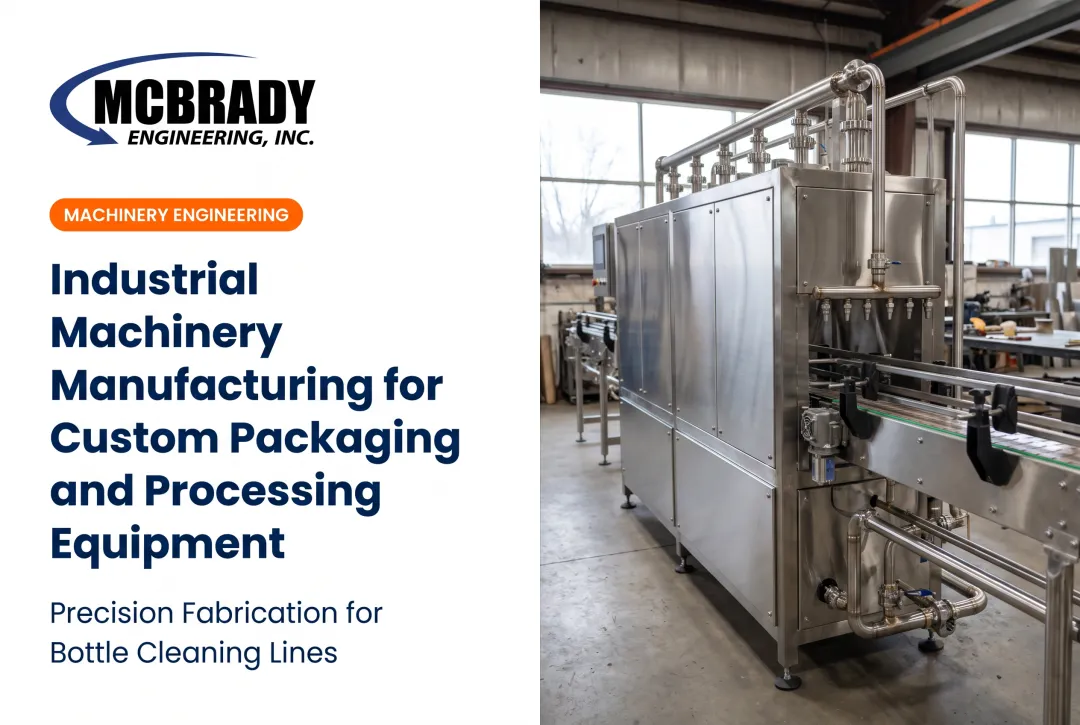
McBrady Engineering, founded in 1961 in Joliet, Illinois, set out to build a compact interior bottle cleaner. The Orbit Bottle Cleaner mounts over an existing conveyor and uses direct tube injection of air, liquid, steam, or gas to clean interiors, including gas-purging new wine bottles before filling.
It ships in five models, with diameters from 36 to 84 inches based on the application. The line then expanded around the same fit-the-line idea:
- Bottle Dusters clear tops, bottoms, sides, and rims at up to 400 containers per minute, with tool-less changeovers across four models
- Model #41 Exterior Vial Washer/Dryer rinses and dries vials up to 50 mL at up to 500 per minute in about 8 feet of line space
- Anti-corrosive cleaners use plastic, fiberglass, and titanium where metal contact is prohibited
- A 4-belt unscrambler/single filer turns randomly fed containers into single file for downstream equipment
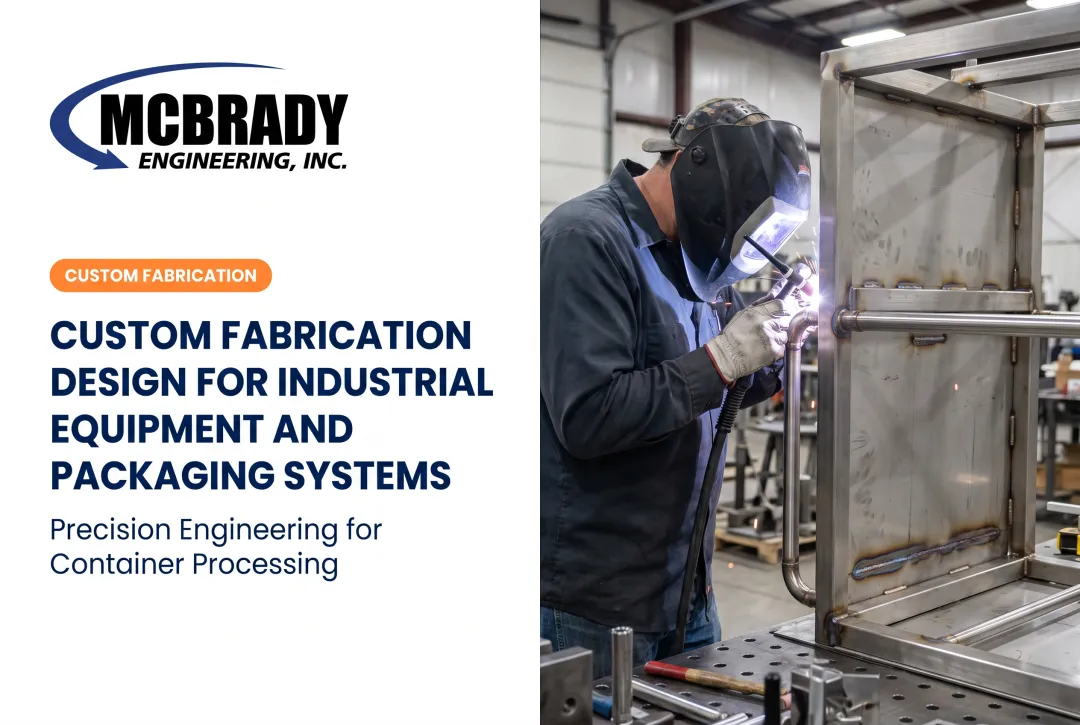
Beyond standard machines, McBrady's engineering and fabrication group builds prototypes and one-offs with 3D modeling and finite element analysis. Fabrication covers 304 and 316L stainless with TIG welding and passivation on every weld.

The right design still starts from the job: a bottle sample, a line constraint, and a defined cleaning goal beat any generic industry label or catalog sheet.
How to Choose a Custom Manufacturing Partner and Request a Quote
Not every fabricator is equipped for custom packaging machinery. Before committing, check for:
- Relevant machinery experience with containers similar to yours
- In-house engineering and fabrication resources (not outsourced)
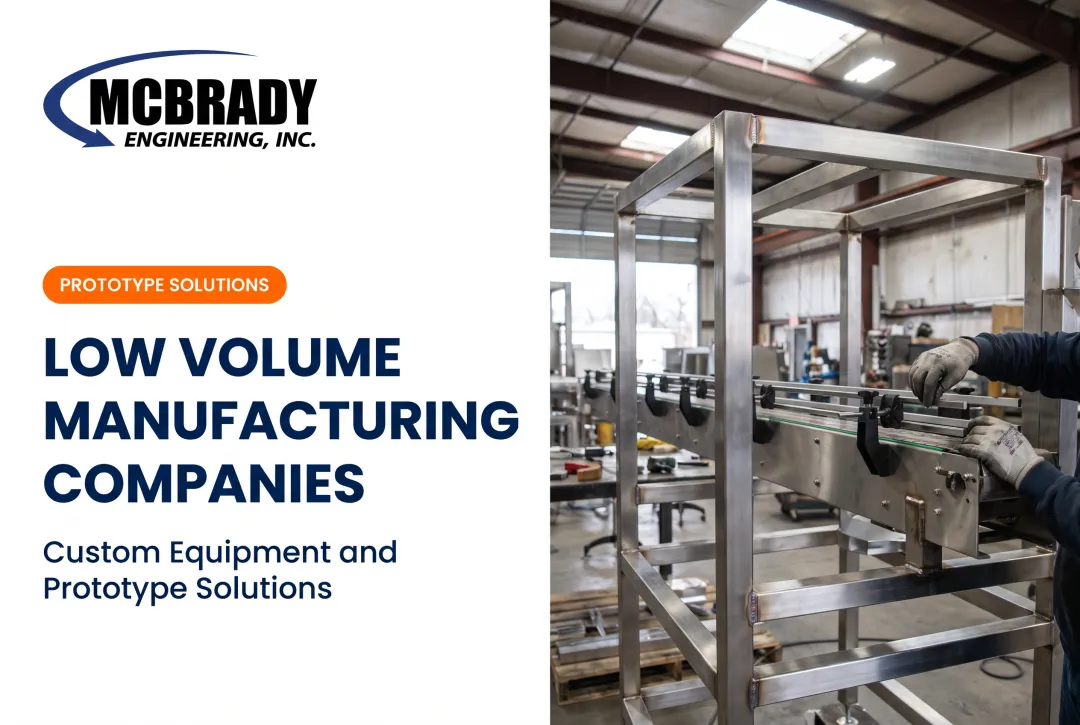
- A track record of prototypes or one-off builds, not just repeat catalog runs
- Familiarity with integrating into existing packaging lines
- A documented, responsive communication process
- Support available for US-based installation and service
What to Include in Your RFQ
A strong request for quotation should spell out:
- Equipment purpose and expected line speed
- Container specifications and samples, if available
- Cleaning or handling requirements
- Layout constraints and operating environment
- Available utilities and connection points
- Desired delivery scope (full machine vs. module)
- Required testing or documentation
Ask prospective manufacturers how they handle design reviews, design changes, material selection, testing, installation, commissioning, maintenance access, and post-delivery adjustments. Their answers tell you more about fit than any brochure will.
If you're working through a container-cleaning or fabrication challenge that standard equipment hasn't solved, reach out to McBrady Engineering at sales@mcbradyengineering.com or (815) 744-8900 with your application requirements.
Frequently Asked Questions
What does "custom manufacturing" mean?
Custom manufacturing builds equipment around a customer's specific requirements—dimensions, functions, materials, production conditions, and line integration—instead of selling an unchanged standard machine.
Can you give me an example of custom manufacturing?
A bottle-cleaning machine engineered for a specific container shape, interior cleaning objective, and line speed is a typical example. A custom guide or transfer module built to fit between two existing machines works the same way.
How do I get custom-made products?
- Define the application and gather drawings, container samples, and operating data.
- Contact a manufacturer with matching engineering and fabrication experience.
- Review feasibility and design proposals, then agree on testing and delivery terms.
What is a manufacturing service?
A manufacturing service covers the engineering, fabrication, assembly, testing, and modification work needed to turn a design or operational requirement into a working product or machine, whether that's a full system or a single custom component.