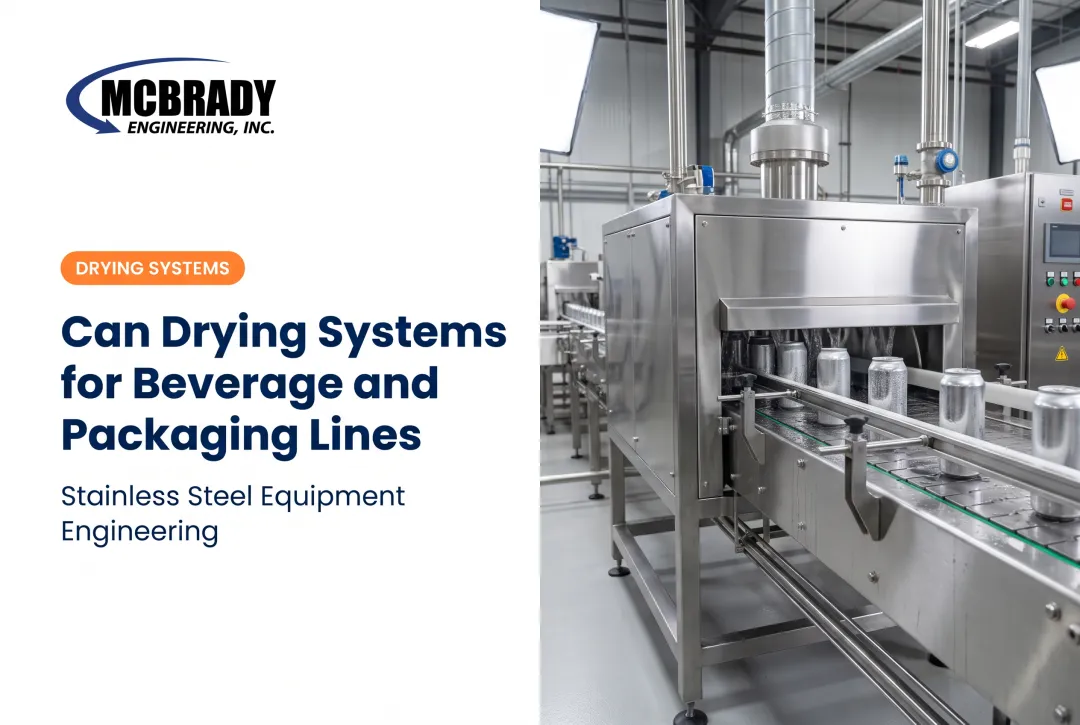

Drying system solutions use controlled airflow, heat, pressure, vacuum, or mechanical action to pull liquid off targeted surfaces after washing, rinsing, or processing. They're the step between "clean" and "ready for the next process."
This guide covers how these systems work, the main drying methods available, where they apply across bottles and equipment, and how to pick the right one for your line.
Key Takeaways
- Match the drying method to the surface—exteriors, interiors, and industrial equipment need different approaches
- Air volume, velocity, temperature, and container orientation decide how dry a surface actually gets
- Choose systems by production rate, residue type, and sanitation rules—not catalog specs alone
- Spec drying with washing and rinsing as one process, not a standalone purchase
How Industrial Drying Systems Work
Every drying system follows the same basic sequence: a wet container or piece of equipment enters a drying zone, liquid gets displaced or evaporated, moisture-laden air exits the enclosure, and the item moves on at the required dryness level. The machinery behind that sequence varies widely.

The Core Components
Most systems combine several of these parts:
- Blowers that generate the primary airflow
- Manifolds or nozzles that aim air at specific surfaces
- Air knives that form a flat, high-velocity air sheet
- Heaters that raise air temperature to speed evaporation
- Filters that clean the supply air before it reaches product-contact surfaces
- Enclosures, conveyors, and sensors that manage timing and containment
GEA's Ventilo container dryer, for example, positions adjustable air knives around the cap, neck, and body of a bottle, sometimes as close as 1 mm from the surface, and collects the displaced water in a drip tray below. That clearance is specific to that machine, not a universal spec, but it shows how precisely airflow must be aimed. (GEA Ventilo Container Dryer)
Displacement vs. Evaporation
These are two different mechanisms, and mixing them up leads to bad equipment choices.
- Displacement uses high-velocity air to knock droplets off a surface. It is fast and does not rely on heat.
- Evaporation uses heat to turn remaining surface moisture into vapor, which airflow then carries away.
Heat helps with residual moisture that air alone can't shift, but it's not free of risk. Too much heat can warp heat-sensitive plastics, loosen label adhesive, degrade coatings, or damage seals. Any heated-air system needs a temperature ceiling that respects the weakest material on the container.
Why Interiors Are Harder
Bottle interiors complicate things fast. Narrow necks restrict airflow. Deep cavities trap moisture in corners a straight air jet can't reach. Threaded openings create ridges where droplets cling.
Getting air into or through a container without adding contamination or slowing handling is a real engineering challenge. That is why interior drying nozzles are often built differently from exterior air knives.
Performance measures worth tracking:
- Residual surface moisture, checked visually or with a meter
- Air velocity and volume at the nozzle
- Exposure or residence time in the drying zone
- Air temperature, when heat is part of the process
- Energy draw of the blower or heater
None of these numbers transfer cleanly from one machine to another. A system built for 10,000 bottles per hour will specify different velocity and residence time than one built for 150 bottles per minute.
Common Industrial Drying Methods
Most industrial drying falls into a handful of categories, each suited to different geometries and throughput needs.
Forced-Air and Blower-Based Drying
A blower pushes ambient or conditioned air across a surface continuously. This works well for high-volume lines where containers move past a fixed drying zone.
According to Paxton Products, blower-fed systems shouldn't cycle on and off more than six times per hour. Frequent cycling shortens blower life and wastes energy.
Advantages:
- Lower ongoing operating cost than compressed air
- Suited to continuous, high-speed lines
- Fewer moving parts at the point of delivery
Limitations:
- Requires a dedicated blower and ductwork
- Less effective on deep recesses or complex geometry
Air Knives and Targeted Blow-Off
An air knife delivers a narrow, continuous sheet of air at a precise target, such as a bottle shoulder, cap seam, or flat equipment surface. Unlike a general blower, it concentrates force into a small area, which makes it effective for removing stubborn droplets from specific zones without blasting the entire container.
Common targets include:
- Bottle caps and necks
- Shoulders and seams on textured containers
- Flat equipment surfaces after washdown
Heated-Air Drying
Adding heat to the airflow speeds evaporation of moisture the air stream alone doesn't displace. A 2014 Spraying Systems case study describes a beverage manufacturer that used regenerative blowers to feed clean, heated air to air knives and targeted air cannons ahead of printing. The plant saved over $200,000 annually on compressed air costs versus its prior setup.
Heat isn't automatic, though. Before specifying heated air, check:
- Plastic container softening points
- Label adhesive temperature limits
- Coating and seal tolerances
Interior Air-Drying Arrangements
Interior drying typically uses one of these approaches:
- Fixed nozzles positioned at a set insertion depth for consistent containers
- Lance-style nozzles that reach into deeper or narrower cavities
- Inverted containers that use gravity plus air pulses to clear trapped moisture
- Timed air pulses synced to container dwell time on the line
Each option trades off coverage, drainage, and changeover speed differently. Lance nozzles reach deeper but need more precise alignment. Inversion simplifies drainage but adds a mechanical handling step.
Specialized and Hybrid Approaches
Vacuum assistance, centrifugal drainage, dehumidified air, and hybrid combinations all have a place. Suitability depends on moisture target, geometry, and process validation requirements.

CVC Technologies, for instance, makes an inverted bottle air rinser that pairs an air jet with vacuum suction. That unit is documented as a rinsing application, not necessarily a drying step for already water-rinsed bottles.
Quick Comparison
| Method | Best suited for | Key tradeoff |
|---|---|---|
| Compressed-air knife | Short, intermittent bursts | Lower equipment cost, higher ongoing air cost |
| Blower-fed air knife | Continuous high-speed lines | Lower operating cost, requires dedicated blower |
| Heated-air blow-off | Containers with stubborn residual moisture | Faster drying, but heat-sensitive materials at risk |
Drying Applications for Bottles, Containers, and Industrial Equipment
Drying needs shift dramatically depending on what's being dried and what happens next.
Exterior Bottle and Container Drying
After rinsing or washing, exterior surfaces need droplets removed before labeling, coding, inspection, packing, or case handling. A wet label area means poor adhesion. A wet code area means a smeared or unreadable date stamp.
Container shape matters here. Round bottles dry fairly evenly with a standard air knife setup. Tapered, textured, or irregular shapes create pockets where water hides — ribbed surfaces, recessed logos, and asymmetric handles all need airflow aimed at the right angle, not just more of it.
McBrady Engineering's Model #41 Exterior Vial Washer/Dryer handles this with a patented "Zig-Zag" guide pattern that rotates vials through the drying zone, exposing the entire exterior surface rather than relying on a single pass. It handles filled and capped vials and ampoules at up to 500 vials per minute in as little as 8 feet of line space.
Interior Drying for Open Containers
Bottles, vials, jars, and cans all present interior drying challenges tied to neck size, cavity depth, and orientation. A narrow-neck vial needs a different nozzle approach than a wide-mouth jar. Drainage matters too: if a container can't tip or drain during the drying cycle, trapped moisture lingers no matter how much air gets pushed in.
McBrady's Model #10 Manual Cleaner/Rinser addresses this at smaller scale, handling bottles from 10 mL to 4 liters at up to 30 bottles per minute. Operators insert containers into a neck adapter plate while inverted, and direct tube injection delivers air, water, or chemical with an adjustable rinse-cycle timer, useful for lower-volume or specialty runs where a fully automated interior dryer isn't justified.

Industrial Equipment and Washdown Areas
Tanks, tooling, conveyors, and washdown areas bring their own complications: recesses, joints, crevices, and corrosion-sensitive materials that trap moisture long after a visible surface looks dry. Aggressive cleaning residues compound the problem, since any leftover chemical film plus trapped moisture accelerates corrosion on unprotected metal.
For environments where metal contact is completely off the table, McBrady's Anti-Corrosive Cleaners use plastic, fiberglass, and titanium construction instead of standard stainless components.
Industry-Specific Considerations
Requirements diverge sharply by sector:
- Beverage and food: 21 CFR 117.37 requires water contacting food-packaging materials to be safe and sanitary; 117.40 requires equipment to be adequately cleanable and corrosion-resistant. (eCFR 21 CFR 117.37)
- Pharmaceutical: 21 CFR 211.94 requires clean containers and closures, with sterilization or depyrogenation validated where the drug product demands it.
- Chemical and household products: No universal legal dryness threshold exists here — material compatibility and corrosion resistance usually drive the specification instead.
- Contract packaging: Frequent SKU changeovers mean drying systems need to accommodate multiple container shapes without a full retool each time.
How to Choose a Drying System
Start with what "dry" actually means for your product—the target is not the same across applications.
Define the Moisture Objective
Are you removing visible droplets before labeling? Preparing a surface for optical inspection? Meeting a validated dryness spec for a pharmaceutical product? Clearing moisture from an internal cavity before capping? Each goal points toward a different drying zone, nozzle arrangement, and dwell time.
Evaluate the Container Profile
Check these before specifying equipment:
- Material and heat sensitivity
- Shape, diameter, and opening size
- Wall strength (can it handle contact with guides or grippers?)
- Surface texture (smooth vs. ribbed or labeled)
- Stability on a conveyor at speed
Once the container is clear, match the dryer to how the line actually runs.
Match System to Production Conditions
- Line speed: sets how much dwell time the drying zone can offer
- Batch vs. continuous: decides whether cycling blowers on and off is acceptable
- Changeover frequency: drives how adjustable nozzle positioning must be
McBrady's Model #42 Exterior Rinse Tunnel, for example, handles up to 150 bottles per minute in as little as 10 feet of line space and mounts around an existing conveyor—so you can add drying capacity without rebuilding the line.
Compare Utility and Operating Requirements
| Factor | What to check |
|---|---|
| Compressed air | Plant supply capacity vs. dedicated blower |
| Electrical power | Blower horsepower and heater load |
| Filtration | Air quality requirements for food-contact zones |
| Noise | Enclosed vs. open blower housing |
| Maintenance access | Nozzle inspection and filter replacement points |
Assess Sanitation and Maintainability
Look for sloped, non-pooling surfaces, accessible nozzles for inspection, and drainage that doesn't require full disassembly. PMMI's 2025 sanitation report flags poor hygienic design and inaccessible surfaces as recurring problems in food and beverage equipment.
Request a Real Performance Test
Before committing, ask for testing using your actual containers, rinse chemistry, and target line speed. Record:
- Count visible droplets before and after the drying zone
- Confirm line speed held without moisture-related rejects
- Log air and heater utility draw during the run
- Measure noise at the operator station

Integrating Drying With Cleaning and Production Lines
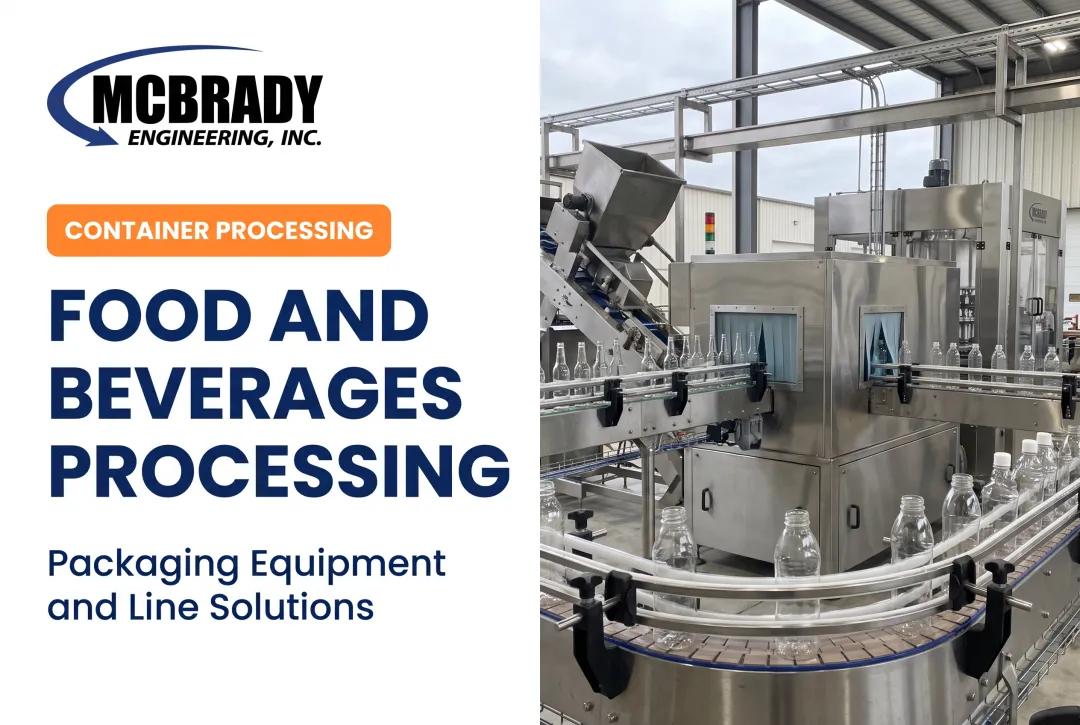
Drying rarely stands alone. A typical line runs loading, cleaning, rinsing, drying, inspection, filling, capping, labeling, and packing in sequence. A dryer sized or positioned wrong becomes a bottleneck everywhere downstream.
Where Drying Sits in the Sequence
Two common placements show up in practice:
- Before filling: clears interior moisture in empty containers ahead of product fill
- After filling, before labeling: removes condensation or rinse residue that can break label adhesion or date coding
Cold-filled bottles can still pick up fresh condensation from seasonal dew-point shifts after an earlier drying stage. Per Air Control Industries' dryer performance review, some lines need drying at more than one point.

Controls and Mechanical Integration
Drying equipment has to coordinate with the rest of the line:
- Conveyor timing
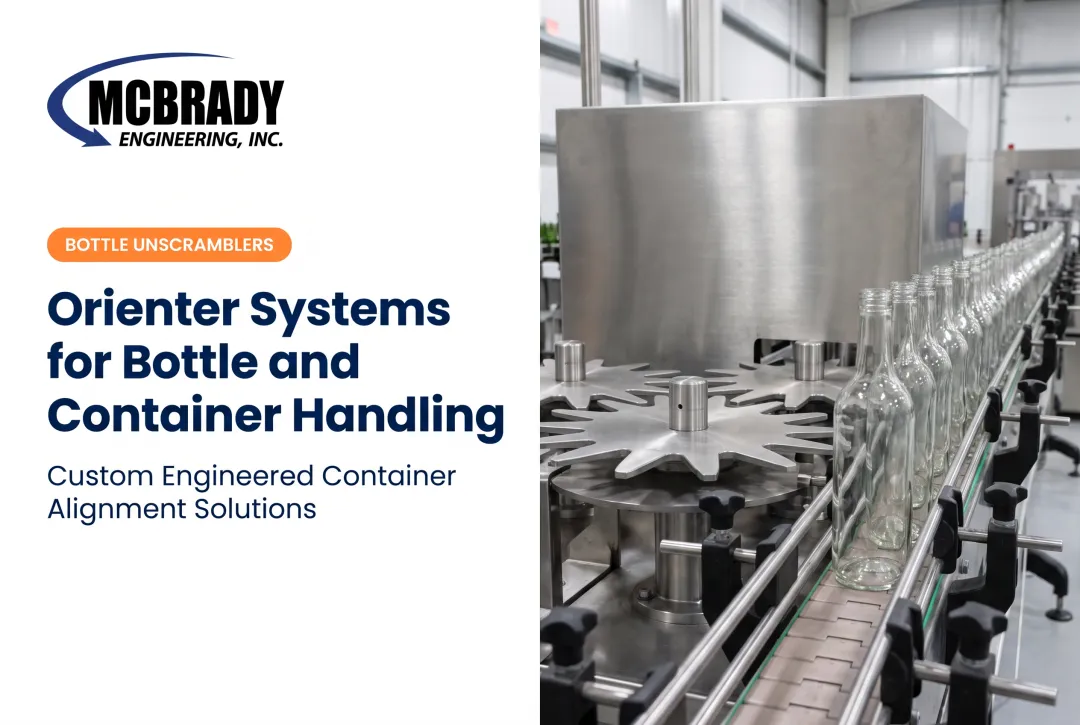
- Container orientation sensors
- Reject handling for containers that fail a dryness check
- Guarding around moving air and blower components
McBrady Engineering's Model #41, for instance, uses infeed and discharge photo eyes to automatically start and stop operation in sync with container flow, plus air and water pressure-loss switches to flag utility interruptions before they create a quality issue downstream.
That same integration mindset runs through McBrady Engineering's broader work. With more than 60 years building interior and exterior bottle-cleaning machinery, the company also engineers custom and one-off wash-and-dry systems when separate machines won't fit the line.
If you're evaluating a custom drying or combined wash-and-dry solution, McBrady's engineering team typically asks for:
- Container drawings and material specifications
- Opening dimensions and wall thickness
- Target throughput (bottles or vials per minute)
- Wash chemistry in use
- Moisture requirements and any validation standards
- Available utilities (compressed air, electrical, heated air)
- Line-layout constraints, including existing conveyor dimensions
Frequently Asked Questions
How does a dryer system work?
A dryer system uses controlled airflow, heat, pressure, vacuum, or mechanical action to remove liquid from a surface. Exact design depends on the required dryness level, container geometry, and line speed.
What are the three main drying methods?
The three broad categories are forced-air or blow-off drying, heated-air drying, and specialized or mechanical methods like vacuum assistance or centrifugal drainage. Terminology varies by manufacturer and industry.
What is the best method for drying?
There's no single best method — it depends on container geometry, material heat sensitivity, moisture target, throughput, available utilities, and sanitation requirements. A pharmaceutical vial and a craft-brewery bottle rarely need the same setup.
What are the different types of drying machines?
Common types include air-knife and blower systems, cabinet or batch dryers, heated-air systems, interior nozzle dryers, and custom integrated drying modules. Equipment names vary significantly between manufacturers, so specifications matter more than labels.