
Introduction: Pharmaceutical Packaging Lines Need More Than Filling Equipment
A filler only performs as well as the vials arriving at its infeed. Before a needle ever touches a stopper, each container has already traveled through cleaning, orientation, and transfer stages that determine whether it arrives clean, upright, and ready.
Many manufacturers struggle to keep this upstream process reliable. Particulate contamination, tipped vials, and inconsistent spacing can shut down a line just as effectively as a filler malfunction.
The FDA notes that drug-product containers must be clean and processed to remove foreign matter before use. That requirement puts real weight on the equipment handling vials before they reach the filling station (FDA, Sterile Drug Products Produced by Aseptic Processing, 2004).
This article covers vial cleaning equipment, vial handling equipment, how they integrate into a full packaging line, and what to evaluate before selecting either.
Key Takeaways
- Vial cleaning equipment can address the interior, the exterior, or both, depending on the container and process risk
- Handling equipment maintains orientation and spacing while cutting down on breakage, tipping, and manual contact
- Cleaning and handling systems should be assessed as part of the full line, not as standalone purchases
- Container cleanliness directly affects particulate risk in sterile and injectable products, per FDA guidance
- Documentation, changeover speed, and integration support matter as much as throughput specs
How Vial Cleaning and Handling Fit Into a Pharmaceutical Packaging Line
A pharmaceutical packaging line is a coordinated sequence of machines that prepares, cleans, fills, closes, inspects, labels, and packs containers. The exact sequence shifts depending on whether you're running bulk glass vials, ready-to-use nested vials, liquid fills, or powder fills, but the upstream logic stays consistent.

A Typical Vial Workflow
Most vial lines follow a similar path:
- Infeed: vials arrive bulk, nested, or pre-oriented
- Unscrambling or orientation: containers are turned into consistent single-file position
- Interior and/or exterior cleaning: particle removal, rinsing, or washing
- Drying: where applicable, typically filtered-air based
- Accumulation: buffering between stations to absorb speed differences
- Filling, stoppering, capping
- Inspection, labeling, secondary packaging
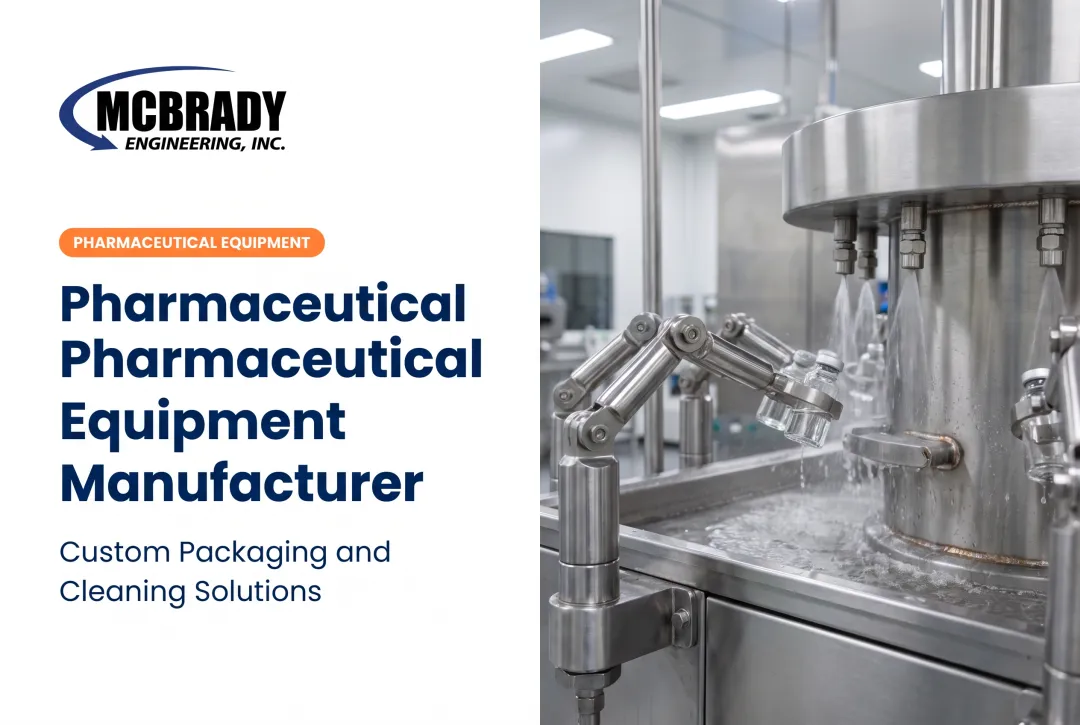
An ISPE account of an automated glassware washer describes this concretely: vials enter on a rotating infeed table, grippers invert them for internal and external washing and drying, then return them upright for discharge (ISPE, Validation of an Automated Glassware Washer, 2025).
Where Problems Start
When cleaning or handling falls short, the symptoms show up downstream, not at the source:
- Tipped vials jamming at the stoppering station
- Inconsistent spacing causing misfeeds at the filler
- Glass breakage introducing particulate into the line
- Bottlenecks forming because accumulation can't absorb speed mismatches
These problems originate upstream and only surface at the filler.
Equipment for Cleaning Pharmaceutical Vials
Vial cleaning splits into two distinct jobs, and conflating them is a common mistake.
Interior cleaning addresses particles or residue inside the container: glass fragments, fibers, or process residue that could end up in the finished drug product.
Exterior cleaning supports presentation, labeling, inspection, and removal of surface contaminants picked up during handling or storage.
No single method covers both needs equally well. Options worth investigating include:
- Filtered air or gas rinsing for particle removal without introducing moisture
- Vacuum-assisted particle removal for dry debris
- Water-based washing where aqueous rinsing is required
- Combination cleaning-and-drying cycles for higher throughput lines
Features to Evaluate
When specifying cleaning equipment, look closely at:
- Nozzle arrangement and coverage pattern
- Container inversion or rotation mechanism
- Controlled air pressure to avoid vial stress
- Filtration on air and water supply
- Drainage and waste handling
- Enclosed construction for contamination control
- Access for inspection and maintenance
McBrady Engineering's lineup illustrates how differently these pieces can be configured. The Orbit Bottle Cleaner uses direct tube injection of air, liquid, steam, or gas for interior cleaning in a compact footprint. The Model #10 Manual Cleaner works as either an air cleaner or water rinser, handling container sizes from 10 mL to 4 liters at up to 30 bottles per minute, with 5-micron and 0.01-micron air filtration.
For exterior cleaning built around vials, the Model #41 Exterior Vial Washer/Dryer washes, rinses, and dries filled and capped vials or ampoules up to 50 mL. It fits in as little as 8 feet of line space and runs 150 to 500 vials per minute.
Its patented zig-zag guide pattern exposes the full vial exterior while keeping the cap area dry through low-pressure washing. The Model #42 Exterior Rinse Tunnel adds flexibility with air, water, or chemical rinsing in an enclosed 6-, 8-, or 10-foot tunnel.

Matching Equipment to Vial Characteristics
Vial diameter, height, neck finish, glass strength, fill volume, and whether containers arrive bulk or nested all shape which cleaning configuration fits. A 2 mL vial and a 50 mL vial don't behave the same way on a rinse line, and neither does a nested-tray format versus bulk feed.
Any of these equipment categories can fit vial applications, but container compatibility, pharmaceutical environmental requirements, and cleaning validation expectations need verification against your specific product before you commit.
Equipment for Vial Handling and Transfer
Cleaning only works if vials arrive in consistent position and leave without damage. That's the job of handling equipment.
Infeed and Orientation
Before vials reach a cleaner or filler, they need consistent position. Common mechanisms include:
- Bulk-vial feeding systems
- Unscramblers and indexing units
- Star wheels and timing screws
- Belts and grippers
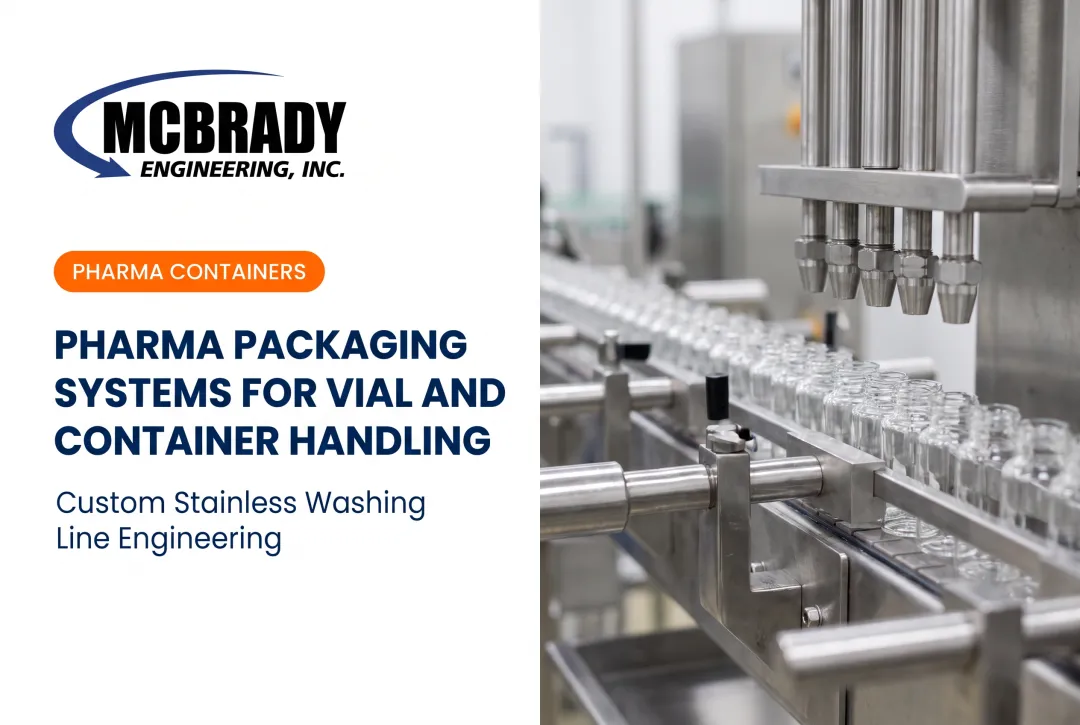
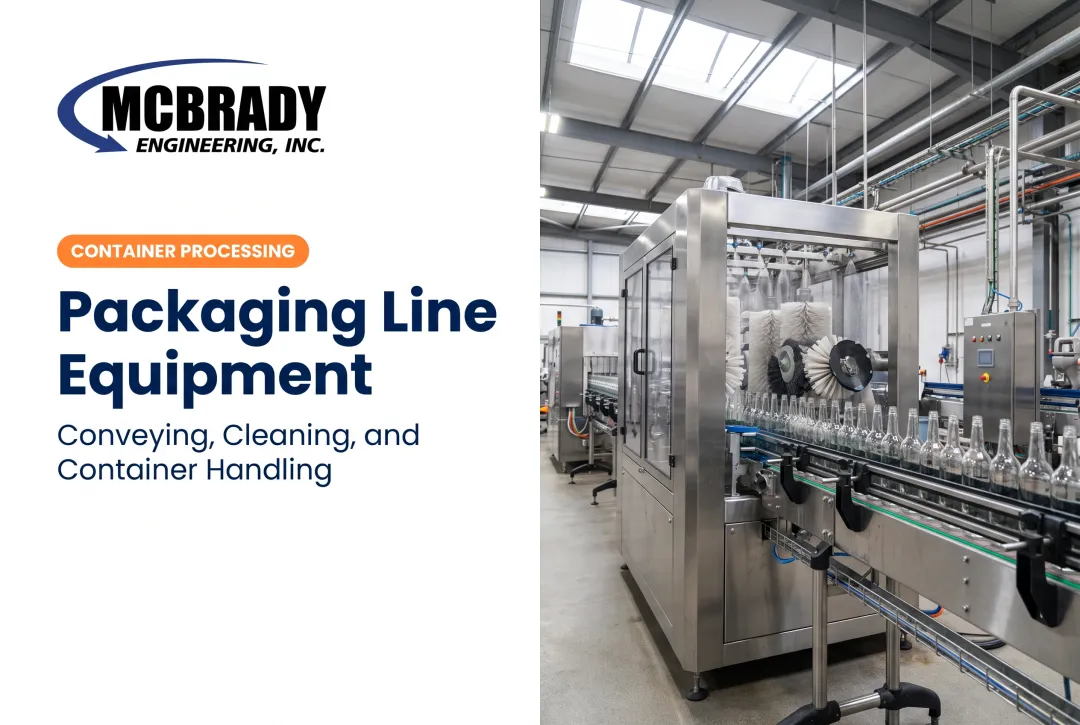
McBrady's 4-Belt Unscrambler/Single Filer uses four Delrin table-top chain-belt conveyors to convert randomly oriented containers into single-file flow, with a fourth reverse belt that pulls excess bottles out and recirculates them to prevent jams. It can be sold paired with a bottle cleaner (mounting directly to an extended discharge belt to eliminate a transfer point) or integrated separately into an existing line.
Protecting Fragile Glass
Glass vials don't tolerate rough handling well. A peer-reviewed study in the PDA Journal of Pharmaceutical Science and Technology found that star wheels and screw feeders can accelerate vials into slower or stationary containers, producing impacts that generate particulates through scratching, not just outright breakage (PDA Journal, Particulate Generation Mechanisms during Bulk Filling, 2017).
In one trial of roughly 8,000 vials, a strengthened, low-friction vial design showed 85% fewer airborne particles near the accumulator table compared to conventional glass, with 80% fewer operator interventions. Both handling equipment design and vial characteristics matter. Features worth prioritizing:

- Controlled acceleration between stations
- Low-impact transfers with guided support
- Contact materials suited to glass
- Jam detection and breakage containment
- Reject removal that doesn't require manual intervention
Flexible Changeovers
Multi-SKU operations need handling systems that adjust without a parts cabinet. McBrady's single-pass washer configurations use no change parts at all: operators adjust rails for a new vial size, verify alignment, and restart. That changeover is simpler than swapping star wheel inserts or timing screw sections for every new format.
Integrating Cleaning and Handling With Downstream Packaging
Cleaning and handling equipment can't be evaluated in isolation. Each module needs to interface cleanly with the filler, stoppering machine, capper, inspection station, labeler, and cartoner that follow it.
Matching points to confirm:
- Line speeds across every station (a 500-vpm washer feeding a 300-vpm filler creates a bottleneck)
- Transfer heights between conveyors
- Accumulation capacity to absorb short stoppages
- Control signal compatibility between machines
Automation ties this together. McBrady's Model #41, for example, includes infeed and discharge photo eyes that automatically halt and restart operation, plus a touchscreen control panel. Broader line-level functions typically include:
- PLC and HMI coordination
- Container-present sensors and jam detection
- Reject confirmation and vision inspection
- Fill-level checks and batch or recipe management
Regulatory backdrop: FDA's cGMP requirements under 21 CFR 211.63 call for equipment that's "appropriately designed, of adequate size, and suitably located to facilitate operations for its intended use and for its cleaning and maintenance."
Section 211.67 adds requirements for cleaning and maintenance schedules, written procedures, and inspection records. Section 211.94 requires written specifications, testing methods, and cleaning methods for containers and closures (FDA, Sterile Drug Products Produced by Aseptic Processing, 2004).
These requirements aren't a checklist you complete once. They need interpretation by qualified pharmaceutical quality professionals against your specific product, process, and facility. Equipment vendors can support documentation, but they don't replace your quality unit's judgment.
How to Select Vial Cleaning and Handling Equipment
Selection starts with defining the process, not browsing a catalog.
Define the Process First
Document these specifics before evaluating equipment:
- Vial material, dimensions, and neck finish
- Container source (bulk, nested, or pre-oriented)
- Product type and sterile versus non-sterile process
- Cleaning objective (interior, exterior, or both)
- Required throughput and operating schedule
- Available floor space
Evaluate Hygienic Design
Look for smooth, accessible surfaces with minimal contamination traps. Check drainage and waste management, enclosure requirements, and compatibility with your facility's environmental controls. A line destined for a cleanroom has different surface and access requirements than one in a general production area.
Compare Automation and Flexibility
Consider:
- Number of vial sizes and SKUs run through the line
- Batch sizes and changeover frequency
- Current manual intervention points
- Target line speeds
- Accumulation needs between stations
- Room for future capacity expansion
Require Proper Documentation
Expect documentation packages to include:
- Equipment specifications and drawings
- Material certificates where applicable
- Operating and maintenance manuals
- Control documentation
- Factory and site acceptance testing support
- Qualification support appropriate to your validation process
Look Past Purchase Price
Total cost of ownership goes beyond sticker price. Factor in:
- Maintenance access and spare parts availability
- Operator training and cleaning time between batches
- Changeover labor and downtime risk
- Energy and utility demand
A cheaper machine that takes 45 minutes to change over costs more over a year than a slightly pricier one that takes 5 minutes.
Standard equipment won't always fit a specialized layout or a one-off container-cleaning requirement. McBrady Engineering's custom engineering and fabrication services, including 3D modeling, finite element analysis, and stainless steel fabrication, fit applications where an off-the-shelf configuration doesn't match the line. That said, any custom build still needs the same validation and qualification scrutiny as standard equipment.
Conclusion: Build the Vial Process Around Controlled Cleanliness and Movement
Reliable vial packaging comes from cleaning, orientation, transfer, accumulation, filling, closing, inspection, and packaging equipment working at matched speeds with shared controls.
Start by defining your vial and process requirements in detail. Then work with equipment engineers and your pharmaceutical quality team to verify compatibility, integration, documentation, testing, and qualification needs before any purchase order goes out.
Frequently Asked Questions
What is a packaging line?
A packaging line is a connected sequence of equipment that prepares, fills, closes, inspects, labels, and packs a product. For vial operations, that sequence typically runs from cleaning and orientation through filling, stoppering, capping, and final packaging.
What are the FDA requirements for pharmaceutical packaging?
Applicable requirements depend on the specific product and process. Refer to current FDA cGMP regulations, your facility's validated procedures, and documentation standards, and consult qualified regulatory or quality professionals rather than relying on a simplified checklist.
What are the types of pharmaceutical packaging?
Primary packaging is in direct contact with the drug product, such as vials. Secondary packaging, like cartons, is not in direct contact. Tertiary packaging covers shipping cases and pallets. Vial cleaning and handling primarily support the primary-packaging stage.
What equipment is used to clean pharmaceutical vials?
Common options include interior air or gas rinsing systems, water-based washing equipment, drying stations, and dedicated exterior cleaning machines, often tied together with integrated controls. The right combination depends on vial type, fill process, and cleanliness requirements.
How are vials handled on a pharmaceutical packaging line?
Vials move through infeed, orientation, spacing, conveying, accumulation, and transfer before reaching the filler, stoppering, and capping stations, followed by inspection and reject handling. Good handling design minimizes breakage, tipping, and unnecessary manual contact at every transfer point.