
Common pressures include:
- Limited floor space
- Frequent product or container changeovers
- Variable production volumes
- Cleanliness and sanitation requirements
- Labor constraints
- The need to scale gradually, not all at once
This article walks through a practical framework: defining what "small-scale" actually means, choosing the right equipment, integrating container cleaning, controlling total cost, and planning for growth without overbuilding.
Key Takeaways
- Small-scale lines should match your actual containers, volumes, and changeover patterns, not a generic industry template.
- Modular, selectively automated equipment improves consistency without the price tag of a full high-speed system.
- Total cost includes installation, labor, utilities, maintenance, and downtime, not just the sticker price.
- A good supplier demonstrates equipment on your containers and supports you well past the sale.
What Small-Scale Production Means for Packaging Operations
There's no industry-wide speed cutoff that defines "small-scale." PMMI, the packaging industry's trade association, categorizes equipment by manual, semi-automatic, or automatic operation rather than a universal bottles-per-minute threshold (PMMI's packaging inquiry form). What one OEM calls entry-level, another might call mid-range.
Wild Goose, for example, markets its Gosling 2.0 as an entry-level canning system rated at up to 12 cans per minute. That's a stated machine capacity for one specific unit, not a definition that applies across bottle fillers, vial lines, or full packaging systems.
What actually determines scale for your operation:
- Product mix and run frequency
- Container formats (glass, plastic, cans, vials)
- Staffing levels and shift patterns
- Available floor space
- Expected growth trajectory
Small Line, Small Factory, or Small Business — Not the Same Thing
Don't confuse facility size with production capability. The SBA classifies small businesses using NAICS-specific employee and revenue thresholds, and its microbusiness research separately defines that category as firms with 1-9 employees. Neither standard says anything about packaging-line speed or footprint.
A small-scale packaging line can run inside a large facility. A small factory might house a surprisingly capable line. And a small-scale manufacturing business might outsource packaging entirely to a contract packager.
Here's the part that trips people up: a compact line still needs industrial-grade reliability. Sanitation, safety controls, repeatable cleaning cycles, and documented quality procedures aren't optional just because the equipment is small.
Why Packaging Operations Choose Small-Scale Production Lines
Compact, modular equipment lets you match capacity to actual demand instead of guessing at future volume and overpaying today.
Operational advantages:
- Shorter material travel distances between stations
- Lower space requirements, freeing square footage for storage or growth
- Easier operator access for maintenance and quality checks
- Faster changeovers between container formats
- Ability to add stations in phases as volume justifies it
The Trade-Offs You Need to Plan For
Small-scale doesn't mean effortless. Manual and semi-automatic equipment means more operator involvement, which means more dependence on training and consistency between shifts.
Maximum throughput will be lower than a dedicated high-speed line. Setup and cleaning require more attention because you're not relying on automated systems to catch every variable.
Mother Earth Brewing's experience is instructive here: the brewery moved from manual packaging to adding an Econocorp cartoner specifically because labor shortages and a mix of carton and tray formats made manual handling unsustainable. It reported a changeover time of under 20 minutes for the new equipment. That's one documented installation, not a universal benchmark, but it shows the pattern: selective automation solves specific bottlenecks rather than replacing the whole line.
Who benefits most from this approach:
- Craft beverage producers (breweries, distilleries, wineries)
- Small food and beverage packagers
- Pharmaceutical and nutraceutical fillers
- Contract packagers serving multiple clients
- Any operation running several container formats through one line
Core Components of a Small-Scale Packaging Production Line
Most packaging lines follow a similar sequence, though not every operation needs every station:
- Empty-container infeed: bringing containers onto the line, often from an unscrambler
- Container handling and orientation: organizing randomly positioned containers into single file
- Cleaning or rinsing: interior and/or exterior
- Filling: product into container
- Capping or sealing
- Labeling
- Inspection
- Case packing or finished-goods handling

CODI Manufacturing's documented craft-beverage canning line follows this logic closely: depalletizer/infeed, twist rinser, filler-seamer, accumulation table, labeler, date coder, and multipack applicator, with case packing added downstream where needed.
Where Container Cleaning Fits
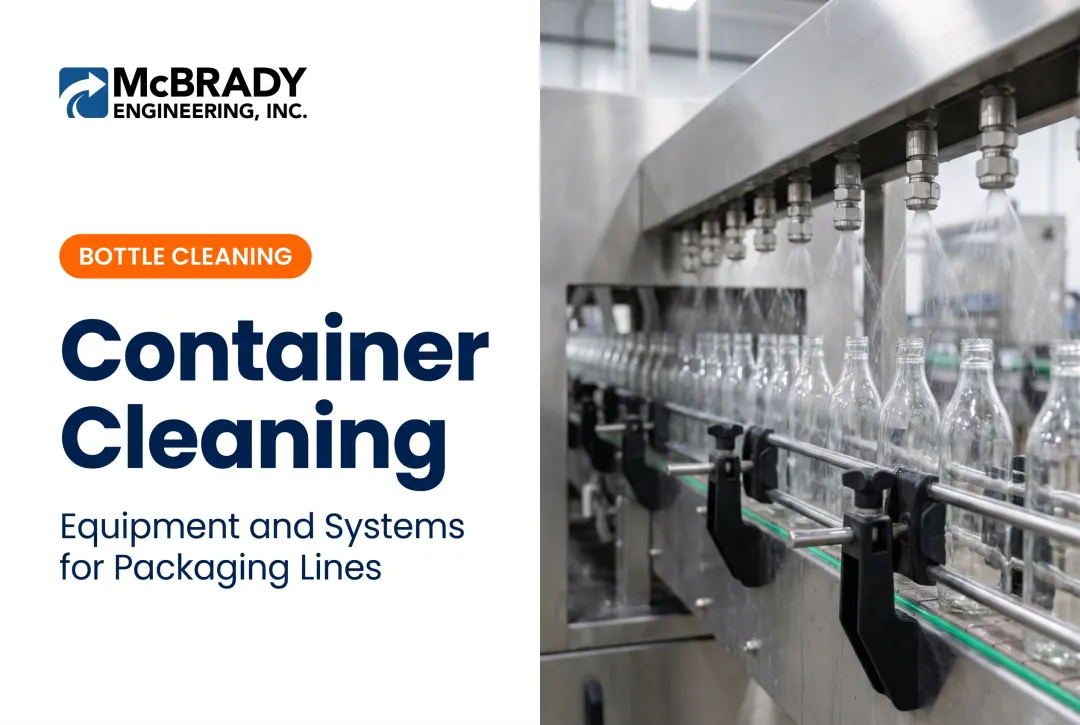
Cleaning happens before filling, and it serves two distinct purposes. Interior cleaning removes dust or loose contaminants that could contaminate the product. Exterior washing or drying supports labeling adhesion, safe handling, and a presentable finished product.
Regulatory requirements vary by product. Bottled water rules under 21 CFR 129.80 explicitly require multiservice containers to be washed, rinsed, sanitized, and inspected immediately before filling. Drug product rules under 21 CFR 211.94 require clean containers and, where indicated, validated sterilization procedures. Neither rule means every container in every industry needs the same treatment. Match the cleaning method to your product and regulatory category.
For operations that need reliable cleaning without dedicating space to a large high-speed system, compact equipment fills this gap well.
McBrady Engineering's Model #10 Manual Cleaner/Rinser, for example, handles bottles from 10 ml to 4 liters at speeds up to 30 bottles per minute. It uses direct tube injection of air, water, or chemical with an adjustable rinse-cycle timer. An operator inserts two bottles, rinses them inverted, and places the cleaned containers on the filling line.
For higher-speed needs without sacrificing a compact footprint, gripper-style cleaners like the HS-300 handle up to 400 bottles per minute with no change parts required between bottle sizes, while units like the ORBIT mount directly over an existing conveyor, using as little as 25 inches of line space.
Manual, Semi-Automatic, or Automated: Making the Call
| Factor | Manual | Semi-Automatic | Automated |
|---|---|---|---|
| Labor requirement | High | Moderate | Low |
| Consistency | Operator-dependent | Improved | High |
| Upfront cost | Lowest | Moderate | Highest |
| Changeover flexibility | High | High | Depends on design |
Labor availability, required consistency, production volume, and budget all factor into this decision. An operation with seasonal volume swings might stick with manual cleaning for off-peak runs and lean on semi-automatic equipment during peak season.
Don't overlook the connective tissue either: conveyors, accumulation areas, change parts, sensors, guarding, and quality checkpoints keep the whole line coordinated. An accumulation table between the filler and downstream packing, for example, lets upstream stations keep running even when a slower downstream process creates a temporary backup.
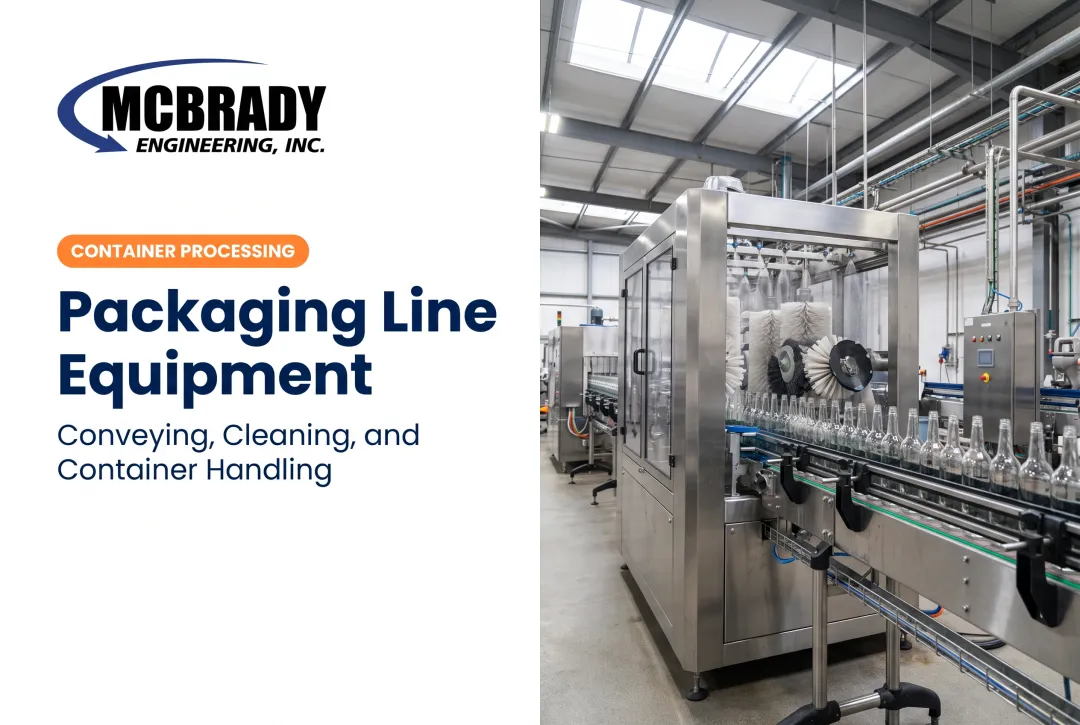
A simple modular configuration for a small beverage operation might look like: bottle unscrambler feeding a compact interior rinser, into a semi-automatic filler, through a capper, then a gripper-style exterior rinse tunnel, finishing at a manual labeling station with visual inspection before case packing.
Each module can be added or upgraded independently as volume grows.
How to Choose the Right Small-Scale Packaging Line
Start with a production-needs assessment before you look at a single spec sheet. Document:
- Container materials, shapes, and sizes
- Closure types
- Product characteristics (viscosity, fragility, chemical sensitivity)
- Required cleaning method
- Operating schedule and batch sizes
- Expected growth over the next 2-3 years
Judge Line Balance, Not Just Headline Speed
A machine's rated capacity means little if it's bottlenecked by the station next to it. Identify your slowest station first. Look for likely accumulation points, manual interventions, and changeover tasks that eat into real throughput.
At Specialty Blends' bottling operation, an HMI button changes tray patterns between 18- and 24-bottle configurations in seconds, but accommodating the line's three bottle widths still requires physical lane-width adjustment. Fast doesn't always mean instant. Pinpoint exactly where the friction remains.

Flexibility questions to ask:
- How quickly can operators change formats?
- How many change parts does each changeover require?
- Can settings be saved and repeated reliably?
- Does the equipment support multiple SKUs or container types without major rework?
Equipment like McBrady's ORBIT addresses this directly, with tool-less changeover requiring only interchangeable parts and no additional adjustment.
Measure the Full Footprint
Don't just measure the machine. Account for operator access, utilities, raw-material storage, finished-goods staging, sanitation space, and maintenance clearance.
Wild Goose's Gosling 2.0 lists a 44 x 26 x 41-43 inch tabletop footprint, but that's the machine alone, not the installed line with infeed, staging, and operator movement space factored in. Budget real floor space, not spec-sheet dimensions.
Total Cost of Ownership Beats Purchase Price
PMMI's OpX Leadership Network frames total cost of ownership around design, operation, maintenance, and environmental factors, not just the invoice (PMMI's TCO guidelines). Build your own comparison around:
- Purchase price and installation
- Utilities (compressed air, water, electricity)
- Consumables and spare parts
- Labor hours required per shift
- Preventive maintenance costs
- Training time
- Downtime risk
- Future upgrade paths
Supplier Reliability Checklist
Before committing, ask potential suppliers:
- What's your expected run size and changeover time for our containers?
- How do you validate cleaning performance for our product category?
- What integration support do you provide during installation?
- How accessible is maintenance, and what's typical parts lead time?
- What documentation do you provide for validation and training?
- What upgrade options exist if our volume grows?
Request a line trial using your actual containers, your cleaning requirements, and your realistic changeover sequence. A demo on a generic test bottle tells you very little about how equipment will perform on your product.
Planning Automation Without Overbuilding
Small operations rarely need to automate every station simultaneously. Selective automation, prioritizing repetitive, ergonomic, safety-sensitive, or quality-critical tasks, tends to deliver better returns than a fully automated rebuild.
Automation type comparison:
| Type | Best for | Changeover effort |
|---|---|---|
| Fixed | High-volume, single SKU | Difficult |
| Programmable | Moderate variety | Moderate |
| Flexible | Multiple SKUs, frequent changes | Low |
For most small packaging operations running multiple container formats, flexible or programmable automation fits better than fixed automation designed for a single product run.
Where to Automate First
Practical first-stage automation targets include:
- Container infeed and orientation
- Rinsing and interior cleaning
- Cap handling
- Labeling
- Inspection and rejection
- Transfer between stations
Fort Collins Brewery's experience illustrates this well. The brewery replaced manual carrier erection and case loading with automated equipment and reported about 20% more output during a normal packaging day.
That's a documented result at that specific facility, not a guarantee, but it demonstrates the value of targeting one genuine bottleneck rather than automating the whole line at once.
Once a station is automated, sensors, basic controls, and vision inspection can improve repeatability substantially. Treat any specific feature claim as something to verify directly with the supplier rather than assume it's included.
A sensible phased roadmap looks like:
- Stabilize the manual process first
- Add ergonomic or semi-automatic modules where labor strain is highest
- Measure actual bottlenecks with real production data
- Automate the station creating the greatest constraint

Evaluate every automation decision by changeover performance, labor impact, and quality consistency, not maximum speed alone. A faster machine that takes 45 minutes to change over between SKUs may cost you more in downtime than it saves in cycle time.
Implementing, Maintaining, and Scaling the Line
Map your process before selecting equipment. This step catches unnecessary movement, repeated handling, sanitation risks, and workflow inefficiencies before they get built into a permanent layout.
Layout options depend on facility constraints:
- Straight-line: Simplest, works well for linear facilities
- U-shaped: Improves operator coverage; still check guard access and material routes
- Cell-based: Groups related stations for flexible, multi-product operations
Whichever layout you choose, account for safe operator access, ergonomics, utility placement, drainage where applicable, and space reserved for future expansion.
Commissioning the Line
- Confirm utilities (power, water, compressed air) match equipment requirements
- Install and align equipment per manufacturer specifications
- Test with your actual containers and materials, not generic samples
- Verify cleaning and handling performance against your standards
- Document all settings for repeatability
- Train operators and maintenance personnel thoroughly
Standard Operating Procedures Matter
Write clear SOPs for setup, changeover, cleaning, inspection, startup, shutdown, jam recovery, and quality-issue escalation. These documents are what keep performance consistent when staff changes or when a new shift takes over mid-run.
Preventive maintenance should cover:
- Wear parts and brushes or cleaning components
- Conveyor belts and rollers
- Sensors and seals
- Controls and electrical panels
Always follow the manufacturer's specific maintenance schedule rather than a generic interval.
Tracking Performance and Knowing When to Expand
Track downtime causes, changeover duration, rejected containers, cleaning results, and labor intervention frequency. These indicators tell you where the line is straining before it becomes a crisis.
Signs it's time to expand:
- Sustained demand increases
- Recurring bottlenecks at the same station
- New container formats entering your product line
- Growing staffing needs that outpace manual capacity
- A shift from semi-automatic toward integrated automation
When your needs move beyond catalog equipment, custom engineering becomes relevant. McBrady Engineering's fabrication capability supports prototypes, one-off container-cleaning requirements, and specialized line modules for operations whose needs fall outside standard equipment lines.
That capability is built around stainless and mild steel construction with TIG welding and passivation on every weld. For container-cleaning modules specifically, custom fabrication fills gaps that off-the-shelf equipment sometimes can't. McBrady Engineering does not supply complete packaging lines.

Frequently Asked Questions
What is small scale production?
Small scale production means manufacturing or packaging products in relatively limited, variable, or batch quantities. The appropriate scale depends on your products, equipment, staffing, and demand, not a fixed industry threshold.
What are some examples of small-scale manufacturing?
Common examples include craft beverage bottling, specialty food packaging, small-batch pharmaceutical or nutraceutical filling, contract packing, and custom container-processing operations serving multiple clients.
What are small factories called?
Depending on size, processes, and industry, they may be called small-scale manufacturing facilities, workshops, plants, production shops, or microfactories. None of these terms imply a specific packaging-line speed or layout.
How do I choose equipment for a small-scale packaging line?
Start with production requirements, container formats, and changeover frequency. Then evaluate footprint, automation level, total cost of ownership, supplier support, and room for future growth.
Is a semi-automatic packaging line suitable for a small business?
Often, yes. Semi-automatic equipment balances affordability and flexibility while leaving room to upgrade specific stations as volume grows, without the cost of full automation upfront.
What should be included in a small-scale bottle-cleaning system?
It depends on whether you need interior cleaning, exterior cleaning, or both. Match the cleaning method to your container type, contamination risk, required line speed, changeover needs, and applicable sanitation regulations.