
Many manufacturers struggle with jams at the filler, inconsistent container spacing, or contamination risks that trigger rework. These aren't minor annoyances. PMMI's 2026 State of the Industry Report found that shorter production runs and expanding SKU counts are pushing packaging operations toward equipment with faster changeovers and greater flexibility, a shift reshaping how lines get built from the ground up.
This article breaks down three equipment categories, conveying, cleaning, and container handling, and the practical criteria you should use to select equipment for a new or existing line.
Key Takeaways
- Packaging line equipment coordinates movement, cleaning, orientation, spacing, and transfer between production stages.
- Conveyors maintain flow, cleaning equipment prepares surfaces, and handling equipment controls position and presentation.
- Configuration depends on container material, dimensions, cleanliness requirements, throughput, and available floor space.
- A qualified supplier demonstrates how equipment integrates with your filler, controls, sanitation, and maintenance plan.
What Is Packaging Line Equipment and Why Does It Matter?
Packaging line equipment refers to the connected machinery and supporting systems that move, clean, orient, inspect, and transfer containers before or during packaging operations. It typically shows up at specific points in the process:
- Container supply and infeed: containers enter the line, often in bulk or randomly oriented.
- Unscrambling or orientation: containers get sorted into a consistent, single-file position.
- Cleaning: interior and/or exterior surfaces get prepared for filling.
- Accumulation and spacing: containers buffer and align before the next station.
- Filling, closing, and labeling: the primary packaging operations occur.
- Downstream packing: finished containers move into cases or secondary packaging.
Why Weak Links Cause Big Problems
Poor equipment selection at any of these stages creates ripple effects. Unstable containers tip. Inconsistent spacing jams the filler. Contamination risks force rework or rejects. Operators end up manually correcting what the machinery should handle on its own.
ANSI/PMMI B155.1-2023, the standard covering packaging and conveying machinery, treats sequential line functions as a coordinated system rather than isolated stations. That distinction matters in practice. Front-end equipment should be evaluated as one integrated system. Controls communication, line speed matching, accumulation capacity, changeover time, cleaning access, and operator safety all need to work together, not just function independently.

A conveyor that runs beautifully on its own but can't talk to the filler's controls will still create bottlenecks. The same goes for a cleaner that does its job perfectly but disrupts container orientation on the way out.
Types of Packaging Line Equipment
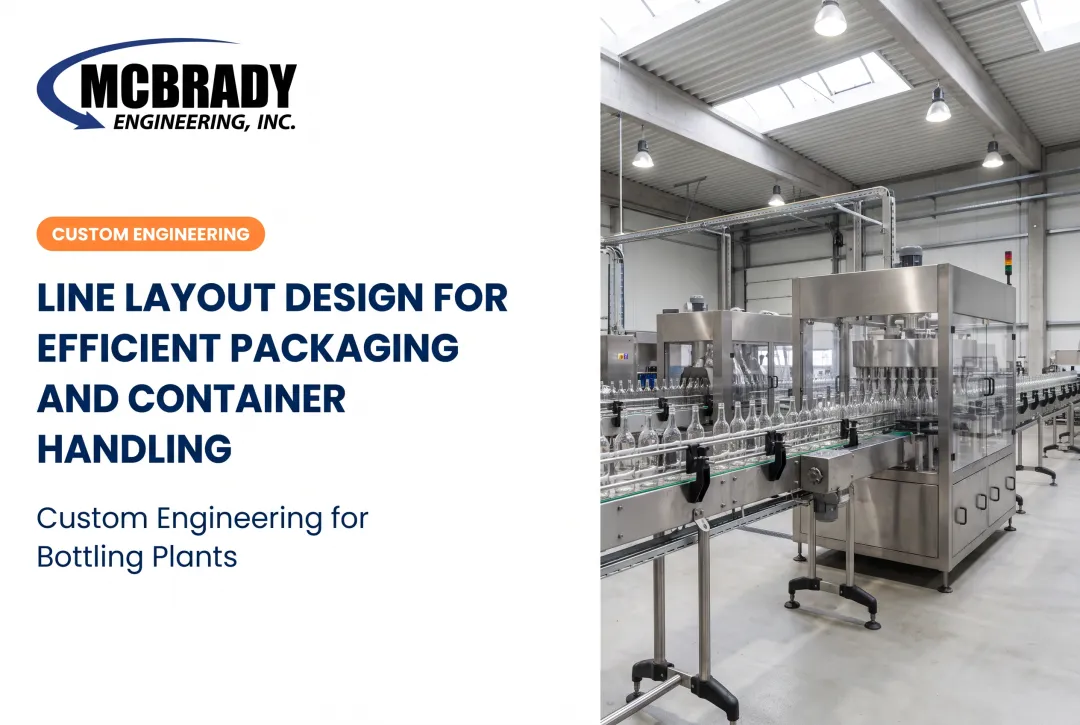
Three equipment categories handle most of the front-end work on a packaging line. Which one you need, and how much of it, depends on container characteristics, cleanliness requirements, line speed, and how your upstream and downstream machines are configured.
Conveying Equipment
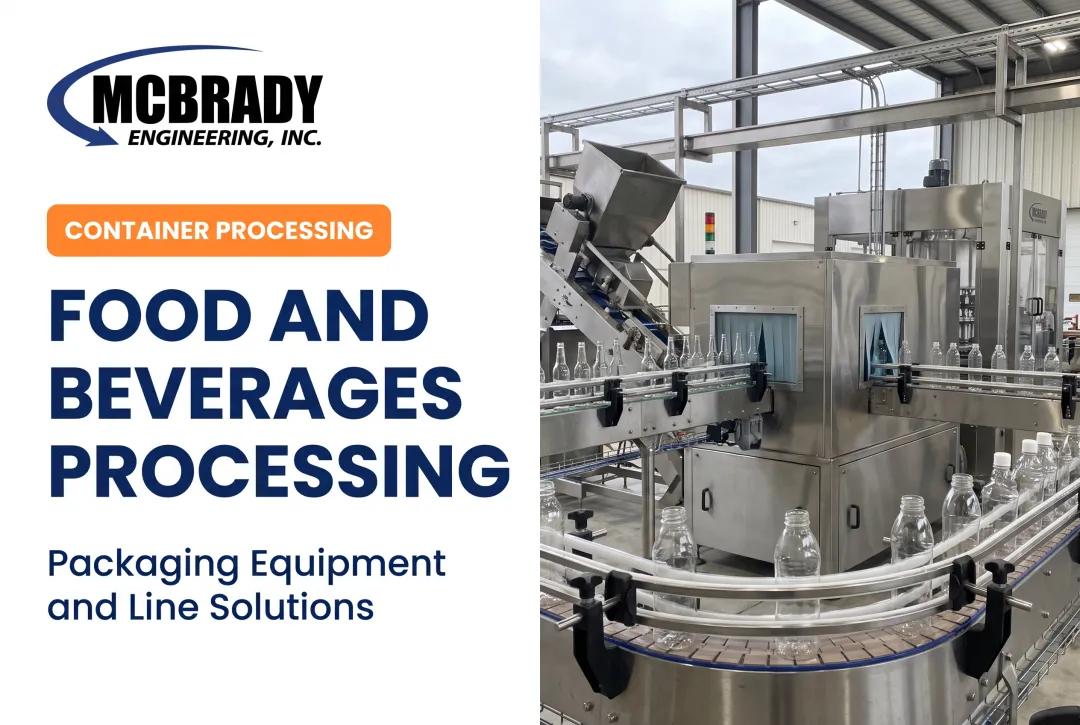
Conveyors transport containers between stations while maintaining spacing, stability, orientation, and a controlled flow into the next machine. Several configurations handle this differently:
- Belt and chain conveying: Narrow TableTop chain suits single-lane work; wider modular MatTop handles mass flow. Belts can stretch or drift off track over time, so plan for that in maintenance.
- Side guides: adjustable rails keep containers aligned through curves and transfers.
- Timing or indexing sections: screws synchronize, group, or space containers precisely before they reach a cleaner or filler.
- Accumulation areas: buffer zones that let part of the line keep running while an issue elsewhere gets resolved.
- Variable-speed control: matches conveyor speed to actual demand instead of running flat-out regardless of downstream capacity.
Conveyor selection shifts significantly depending on the container:
- Glass bottles need gentler handling to avoid scuffing or breakage
- Lightweight plastic can shift or tip at speed
- Narrow-neck bottles and vials often need neck-guide rail support
The trade-off with conveying systems is straightforward: continuous flow and integration flexibility come at the cost of footprint, cleaning access, and transfer complexity. Poorly matched speed or spacing between sections is one of the most common causes of jams on a packaging line.
Container-Cleaning Equipment
Cleaning splits into two distinct jobs: interior cleaning and exterior cleaning. They're not interchangeable, and most lines need to think through which one (or both) applies to their product.
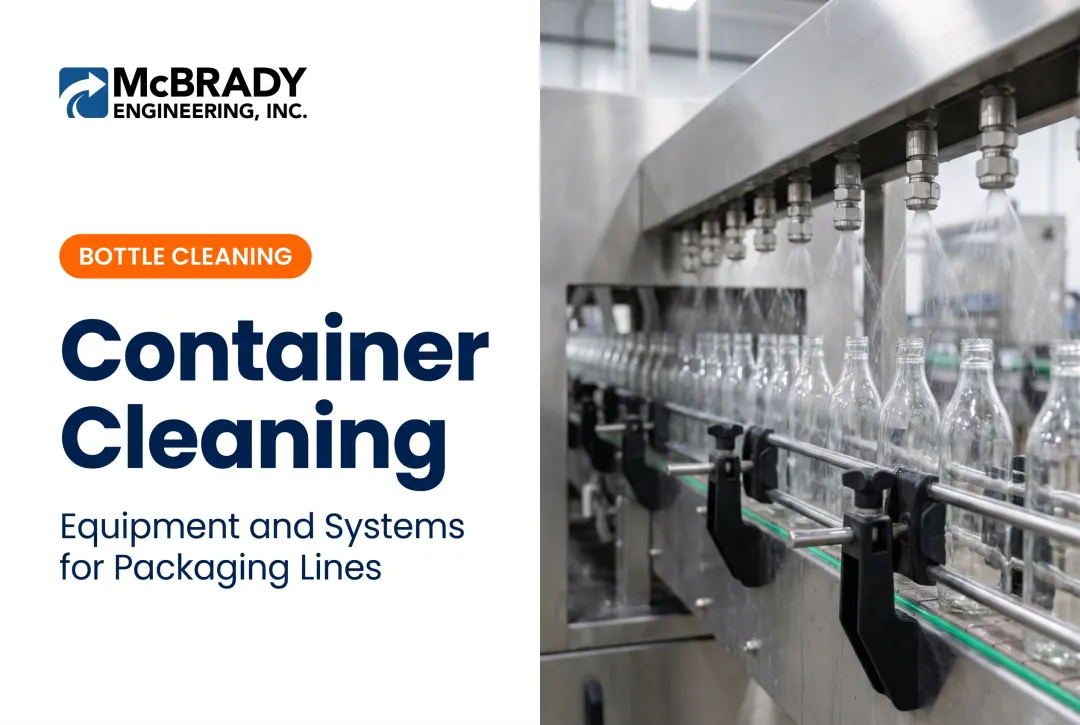
Interior cleaning removes dust, particles, or residue from inside an empty container before filling. This typically uses air, liquid, steam, or a combination, depending on the container and the residue involved.
McBrady Engineering's ORBIT Bottle Cleaner, for example, uses direct tube injection of air, liquid, steam, or gas, and can even gas-purge new wine bottles before filling.
Exterior cleaning addresses contamination on outside surfaces, such as dust from secondary packaging, handling residue, or labeling debris. Equipment ranges from rinse tunnels to dusters that use ionized compressed air, brushing, spinning, or vacuuming.
A typical cleaning sequence follows this pattern:
- Present the container to the cleaning station, often via a gripper or guided conveyor.
- Apply air, water, sanitizer, or another cleaning media.
- Remove and evacuate loosened particles or residue.
- Return the container to the line without losing orientation.

Krones' washing equipment for returnable bottles illustrates one end of this spectrum, using caustic and water immersion baths plus spray zones for heavier-duty washing. That's a very different approach than a dry air rinse, and the right choice depends entirely on the cleaning objective and container condition.
Selection factors worth documenting before you buy:
- Cleaning objective (dust removal vs. residue vs. sanitization)
- Container opening size and geometry
- Moisture tolerance and drainage requirements
- Air and water availability at the installation site
- Washdown conditions in the facility
- Materials of construction (stainless grade, gasket compatibility)
- Compatibility with existing cleaning procedures
Manufacturers focused on compact interior and exterior bottle-cleaning machinery, McBrady Engineering among them, fit lines that need cleaning equipment in a tight footprint without sacrificing throughput.
Container-Handling Equipment
Container handling covers unscrambling, orienting, inverting, gripping, indexing, spacing, transferring, rejecting, and presenting containers to the filler or cleaner. It's the connective tissue between conveying and cleaning.
Handling equipment earns its keep on lines dealing with:
- Mixed container sizes on the same line
- Narrow openings that complicate gripping
- Fragile glass requiring gentle contact
- Lightweight plastic prone to tipping
- Unusual shapes that don't sit well in standard pucks
- Frequent changeovers between SKUs
A 4-belt unscrambler, for instance, uses three progressively moving belts to separate randomly oriented bottles, with a fourth reverse belt removing excess containers to prevent jamming before single-filing them for downstream equipment.
The trade-off here is automation and consistency versus capital cost. More automated handling systems typically require format-specific tooling or adjustments during changeover, and setup complexity increases with the variety of containers a line needs to run.
Handling equipment can't be evaluated in isolation. If it's not matched to the conveyor's speed and the cleaner's infeed requirements, containers lose orientation, collide, or arrive at the next station on the wrong pitch, defeating the purpose of automating the handoff in the first place.
How to Choose the Right Equipment
Start with the process objective, not a preferred machine type. Define the container, the required cleanliness level, the expected production pattern, and the specific problems the new equipment needs to solve. Everything else follows from that.
Container and Product Requirements
Document these details before contacting any supplier:
- Container material (glass, PET, HDPE, etc.)
- Dimensions, neck finish, and opening size
- Shape and weight, including fragility
- Surface characteristics and residue type
- Compatibility concerns with air, water, brushes, or gripping surfaces
Throughput and Line-Flow Requirements
Establish your target containers per minute or hour based on realistic operating conditions, not just rated maximum speed. PMMI ProSource recommends building in roughly 15% excess capacity for future growth. A machine running somewhat below its designed speed typically operates more consistently than one pushed to its limit.

Also factor in:
- Expected operating schedule
- Acceptable accumulation buffer
- Changeover frequency
- Speed of connected upstream and downstream machines
Hygiene, Washdown, and Maintenance
Check cleanability, drainage, and material selection before committing to a configuration. Look for:
- Protected components that won't collect residue
- Accessible wear parts that don't require full disassembly
- Clear inspection points for routine checks
- Documented procedures for cleaning and preventive maintenance
Layout, Utilities, and Integration
Review these factors before you lock in a configuration:
- Available floor space, line height, and operator access
- Compressed-air demand, water and drainage needs, and electrical requirements
- Controls, communication, and safety guarding at connection points to existing equipment
These integration details matter as much as the machine's own specifications.
Flexibility, Lifecycle Cost, and Supplier Support
Look past purchase price and compare:
- Changeover time and format tooling
- Spare parts availability
- Training and service responsiveness
- Total cost of ownership over the equipment lifecycle
For specialized or one-off container-cleaning requirements where off-the-shelf equipment doesn't quite fit, McBrady Engineering offers custom engineering and fabrication, including 3D modeling and finite element analysis, built around the specific container and application.
What to Check Before Finalizing Equipment
Don't choose equipment solely because it has the highest advertised speed. A machine rated for 540 containers per minute on an 8-ounce bottle may perform very differently on your actual containers, with your actual cleaning objective, on your actual line layout.
Verify these before signing off:
- Performance with your containers: ask for a trial run or demonstration with your actual product, not a similar substitute.
- Changeover parts and accumulation capacity: confirm what's included versus what requires additional purchase.
- Transfer points and operator access: walk through how containers move between this machine and the next.
- Drainage and washdown exposure: especially relevant for cleaning equipment installed near wet processes.
- Long-term parts availability: ask how long the manufacturer supports the model you're buying.
Request technical drawings, utility requirements, safety documentation, and cleaning and maintenance instructions upfront. Clarify who is accountable for connecting this equipment to your existing line, and set acceptance-test criteria before the equipment ships.
Conclusion
Conveying, cleaning, and container-handling equipment aren't separate decisions. They work together to create stable, clean, correctly oriented containers for the rest of the packaging line. A conveyor that can't match the cleaner's infeed speed, or a handling system that loses orientation before the filler, undermines the investment in all three.
The best choice matches equipment capabilities to your container characteristics, cleanliness goals, throughput targets, and floor space. Spec-sheet top speed is a poor substitute for that fit.
Changeover requirements and maintenance practices deserve the same scrutiny as performance numbers. Those factors decide how the equipment actually runs once it is installed.
Frequently Asked Questions
What are the 5 requirements of packaging?
Common requirements include product protection, containment, preservation, usability, and identification. Conveying, cleaning, and handling equipment support containment and cleanliness before filling.
What are the four types of packaging?
Packaging is grouped into primary, secondary, tertiary, and quaternary categories, from the bottle itself to pallet-level transport. This article covers equipment that handles primary containers and feeds later packaging stages.
What is a dieline for packaging?
A dieline is a technical template that specifies cut lines, fold lines, and glue areas for cartons or labels. It is a design file, not the mechanical equipment used to convey, clean, or fill containers.
What equipment is used to clean bottles on a packaging line?
Common options include interior bottle cleaners, exterior washers, air rinsers, brushes, rinsing systems, and dryers. The right choice depends on container type and whether you need interior cleaning, exterior cleaning, or both.
How do I choose a conveyor for bottles or other containers?
Match the conveyor to container material and shape, line speed, spacing, and accumulation needs. Also factor in transfer points, washdown conditions, changeover frequency, and compatibility with connected machines.
What is the difference between interior and exterior container cleaning?
Interior cleaning removes particles or residue inside the container using air, liquid, or steam. Exterior cleaning targets outside surfaces; some lines need one method, while others need both.