
Introduction
A standard bottle washer works fine until it doesn't. Maybe your containers are an odd shape. Maybe your facility has 25 inches of line space instead of 50. Maybe you're switching between six SKUs a day and the changeover eats your shift.
Many packaging and processing operations hit this wall: off-the-shelf equipment handles the "normal" case but breaks down the moment a container, cleaning requirement, or footprint constraint falls outside it.
Industrial machinery manufacturing for custom packaging and processing equipment is how builders turn a specific application into reliable, line-ready machinery.
This guide covers common equipment categories, how custom machines get designed and built, what separates a strong manufacturer from a weak one, and the questions worth asking before you commit.
Key Takeaways
- Industrial machinery manufacturing covers engineering, fabrication, assembly, testing, and ongoing support, not just equipment sales.
- Match packaging equipment to container geometry, throughput, cleaning method, footprint, and changeover frequency.
- A strong manufacturer shows relevant application experience and supplies real installation and maintenance documentation.
- Custom engineering earns its keep on prototypes, one-off builds, and lines that standard equipment simply can't serve.
What Is Industrial Machinery Manufacturing for Packaging and Processing?
Industrial machinery manufacturing is the design and production of machines that perform a repeatable task, not the resale of someone else's catalog item.
PMMI, the trade association for packaging and processing technology, draws this line explicitly. Its manufacturer membership category is separate from its new-equipment distributor category, and manufacturer applications are verified with a plant visit. If a company can't show you where the welding, assembly, and testing happen, it's reselling, not manufacturing.
The Typical Project Lifecycle
Most custom machinery projects move through a similar sequence:
- Application discovery — understanding the container, product, and process
- Mechanical and electrical design — turning requirements into drawings
- Material selection — matching metals and finishes to the product and environment
- Fabrication and assembly — building the physical machine
- Testing — confirming the machine does what the design says it will
- Delivery and support — installation help, training, and parts

Where projects differ is how much of that sequence starts from an existing platform versus a blank page.
Standard, Modified, or Fully Custom?
There's no formal industry-wide definition splitting "standard," "modified-standard," and "fully custom" equipment into three categories. PMMI reporting on packaging and processing trends points to growing demand for modular, quick-change machinery that handles shorter runs and more SKUs.
In practice, buyers choose based on how closely their container and process match what's already built — not based on a published tier system.
Packaging and processing machinery also carries a wrinkle general industrial equipment doesn't: it rarely runs alone. A bottle cleaner has to match conveyor height, feed a filler at the right rate, and leave room for labeling and inspection downstream. Custom design means accounting for the whole line, not just the one machine.
Examples of Custom Packaging and Processing Equipment
Custom packaging machinery usually falls into a few functional categories.
Container Cleaning: Interior and Exterior
Interior and exterior cleaning solve different problems, and equipment is usually built for one or the other:
- Interior cleaners/rinsers remove dust, debris, or residue before filling. McBrady's Orbit Bottle Cleaner uses direct tube injection of air, liquid, steam, or gas across five models for standard, odd-shaped, and puck-held bottles.
- Exterior cleaners handle the outside: tops, bottoms, sides, and rims. A bottle duster using ionized compressed air, brushing, and vacuuming removes surface dust and powder without touching what's inside.
- Exterior rinse tunnels mount around an existing conveyor and rinse with air, water, chemical, or a mix—often in 6', 8', 10', or custom lengths to fit line space.
The FDA's bottled-water equipment rule is a useful anchor point here — it explicitly names bottle washers, fillers, and cappers as equipment that must use materials suitable for product contact and capable of being adequately cleaned and sanitized.
Packaging-Line Equipment Categories
A typical packaging line combines several machine types:
| Category | Function |
|---|---|
| Rinsing systems | Remove dust/debris before filling |
| Washing and drying | Clean and dry containers post-fill or pre-fill |
| Conveyors | Move containers between stations |
| Positioning/unscrambling | Orient random containers into single file |
| Filling and sealing | Add and close product |
| Labeling and inspection | Apply labels, verify fill/label accuracy |
| Case/carton handling | Group containers for shipping |
An unscrambler that takes randomly oriented containers and converts them to single file is a good example of how one function — orientation — can determine whether everything downstream runs smoothly or jams constantly.
Matching Equipment to the Customer
Different operations need different things from the same basic machine category:
- Craft breweries, distilleries, and wineries often need low-footprint, semi-automatic rinsing rather than a full high-speed system.
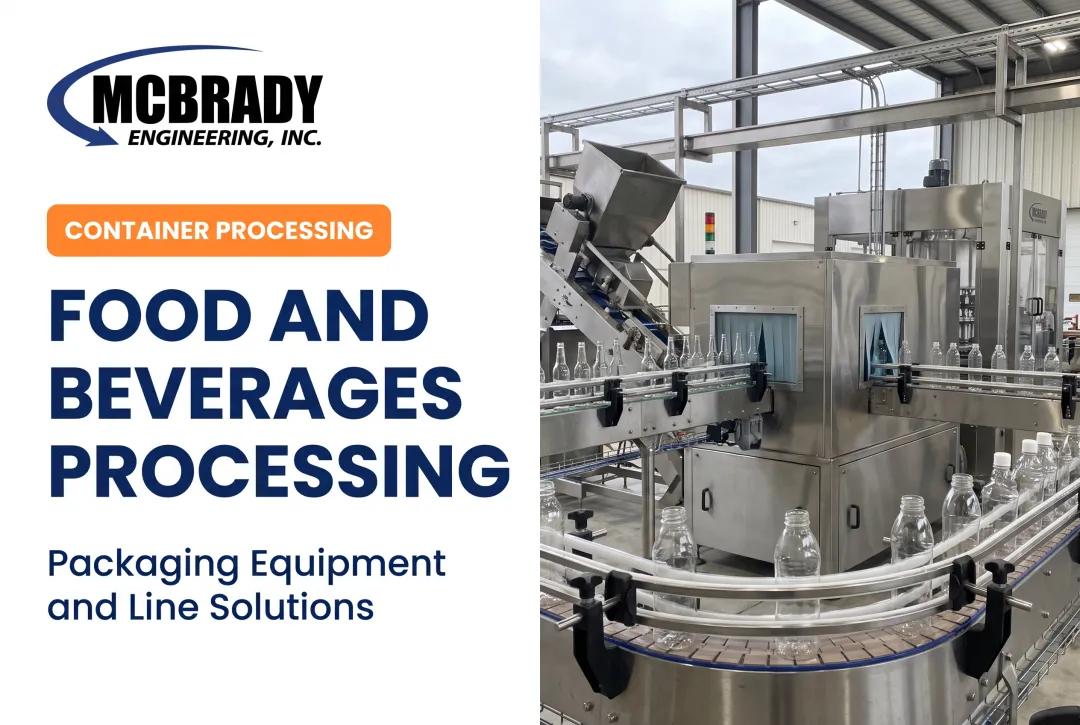
- High-speed bottlers (water, juice, soda, dairy) need inline cleaners that keep pace with fast fillers without becoming the bottleneck.
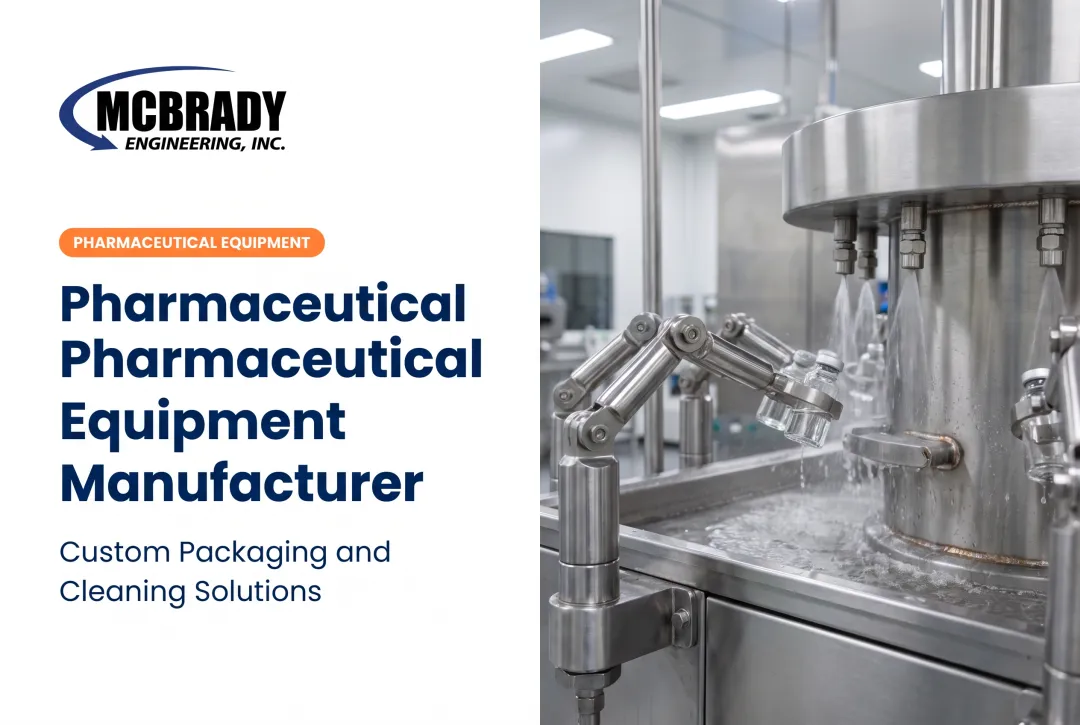
- Pharmaceutical and lab vial fillers need both interior rinsing and exterior washing/drying to meet cleanliness expectations before labeling.
- Chemical and household-product fillers deal with washdown environments and aggressive residues that can degrade standard stainless equipment.
- Contract packagers running multiple SKUs need equipment that changes over fast between bottle shapes and sizes.
- OEMs and integrators often specify a cleaning module as one component inside a larger line they're building.
Standard vs. Custom: What Actually Matters
Purchase price is easy to compare and often the least useful signal. Total fit matters more:
- Handles your real container geometry, not a near match
- Integrates cleanly with your existing line
- Stays accessible for cleaning and maintenance
- Scales or reconfigures when your product mix changes
How Custom Industrial Machinery Is Designed and Manufactured
Custom machinery starts with information, not a drawing board.
Requirements Discovery
Before any design work begins, a manufacturer needs:
- Container drawings or physical samples
- Dimensions and materials
- Production targets (containers per minute)
- Contamination type and cleaning method
- Available utilities (air, water, electrical)
- Floor space and operating environment
- Changeover expectations
- How the machine connects to existing equipment
Engineering and Design Review
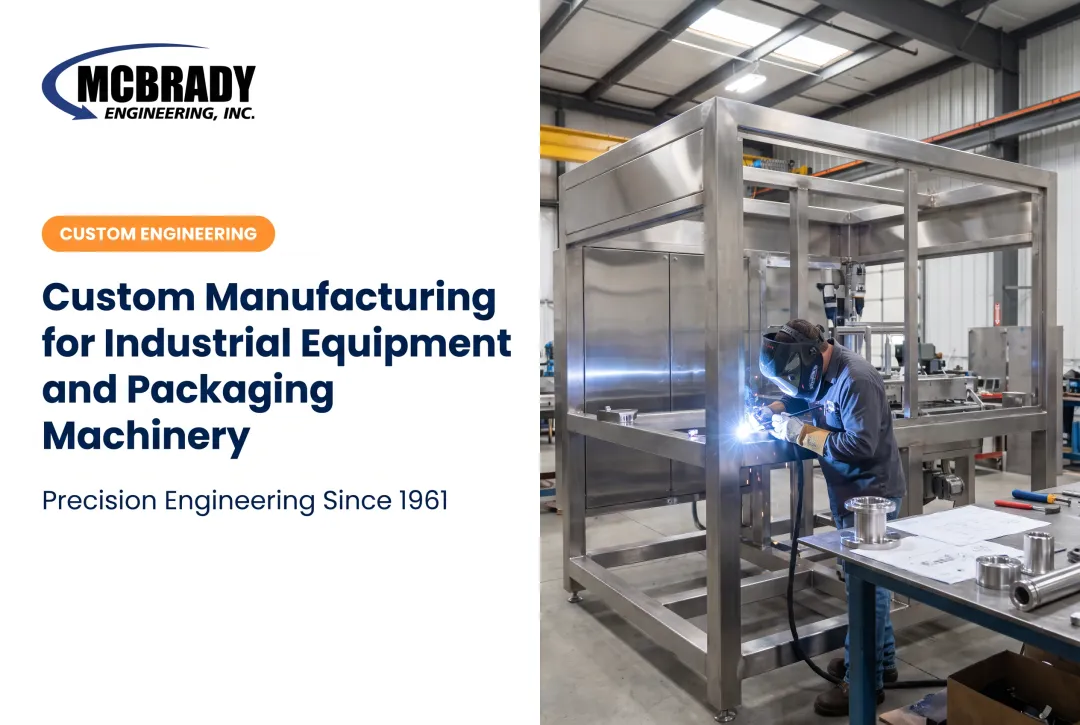
This stage turns requirements into something buildable. McBrady's engineering department works through 3D modeling, full-scale assembly drawings, finite element analysis, and 2D drawings. Customers get something concrete to review before metal gets cut.
Material selection happens here too: stainless steel (304 or 316L) for sanitary applications, mild steel where corrosion resistance matters less. Access points for cleaning and maintenance are built into the layout rather than added later.
Fabrication, Assembly, and Testing
Fabrication typically covers:
- Cutting, forming, welding, and machining
- Building subassemblies into a finished machine
TIG welding is standard for sanitary equipment. Passivation on every weld reduces corrosion and contamination risk at the seam, and pharmaceutical-grade welding is available when the application calls for it.
Once the machine is built, testing confirms it is safe and fit for the line. Safety standards like ANSI/PMMI B155.1-2023 call for risk assessment that covers the machine and how it coordinates with other packaging functions—not just the standalone unit. Container trials, cleaning verification against customer-defined criteria, and a safety review should all happen before anything ships.

Installation, Integration, and Support
Once the machine arrives, success depends on:
- Conveyor alignment with upstream/downstream equipment
- Utility connections matching the design spec
- Guarding and operator access points
- Coordination with other equipment suppliers on the line
Afterward, support should include operator training, maintenance instructions, guidance on wear parts, and a clear path for handling future format changes.
Buyer checklist before the first call:
- Container samples or drawings
- Target throughput (units per minute)
- Cleaning or contamination challenge
- Available floor space (length, width, conveyor height)
- Utilities on hand
- Changeover frequency and format range
How to Evaluate a Custom Packaging Machinery Manufacturer
Not every machinery builder has experience with your container type, process, or production scale. Use the checks below to separate a workable partner from a risky one.
Experience and Capability
Look for direct evidence on your container type, cleaning or processing challenge, and production scale—not adjacent work alone. Ask whether they run prototypes and one-off builds, or only fixed product lines.
Strong capability signals include:
- Custom drawings and design revisions based on your feedback
- In-house fabrication and welding rather than heavy subcontracting
- Proven work at your production volume
Partners built for custom packaging work, such as McBrady Engineering, typically combine standard equipment lines with prototype and one-off fabrication so scope matches the application.
Reliability and Documentation
Reliability shows up in details that are easy to overlook during a sales pitch:
- Access for sanitation and routine maintenance
- Availability of replacement/wear parts
- Operator ergonomics at the machine
- Material compatibility with your product
Ask what documentation ships with the machine. At minimum, that should include layouts, utility requirements, operating instructions, a maintenance schedule, a parts list, and acceptance criteria. PMMI's guidance on factory acceptance testing exists specifically because unclear criteria and undefined responsibilities between OEM and end user cause cost overruns and delays. If a manufacturer can't tell you how acceptance will be verified, that's worth a second look.
Comparing Proposals Beyond Price
A lower quote with vague scope boundaries usually costs more later. Compare:
- Scope boundaries (what's included vs. billed separately)
- Lead time assumptions
- Who's responsible for integration
- Testing arrangements and acceptance criteria
- Installation support and warranty terms
- Future modification and service availability
Why Communication Matters
Custom machinery projects rarely involve one decision-maker. Operations, engineering, quality, maintenance, procurement, and sometimes an outside OEM or integrator all sign off on the final design. A manufacturer who asks detailed technical questions upfront reduces surprises during fabrication.
Questions worth asking a prospective manufacturer:
- Have you built equipment for this container type or cleaning challenge before?
- Who does the engineering, fabrication, and welding — in-house or subcontracted?
- What does acceptance testing look like, and who signs off?
- What documentation ships with the machine?
- What's your typical lead time from signed drawings to delivery?
McBrady Engineering's Custom Machinery and Bottle-Cleaning Capabilities
McBrady Engineering was founded in 1961 with one goal: build the best compact interior bottle cleaner on the market. The result was the Orbit Bottle Cleaner, which became successful enough to spawn an entire line of interior and exterior bottle-cleaning machinery.
More than 60 years later, that same focus on compact, efficient, reliable cleaning equipment still anchors the company, alongside custom engineering and fabrication for prototypes and one-off solutions.
That combination matters to a specific set of customers:
- Beverage bottlers, craft breweries, distilleries, and wineries needing rinsing systems sized to their actual line speed
- Pharmaceutical and laboratory vial fillers needing both interior and exterior cleaning before labeling
- Chemical and household-product packagers dealing with aggressive residues standard equipment can't handle
- Contract packagers, OEMs, integrators, and machinery representatives specifying or reselling a cleaning module as part of a larger line
McBrady operates from more than 30,000 square feet of manufacturing space in Joliet, Illinois. The company has delivered machinery and service throughout the United States and more than 30 countries worldwide.
If your operation needs specialized interior or exterior container cleaning, a compact footprint solution, or a one-off engineered machine, McBrady is worth an engineering conversation. Every application still deserves its own review before assuming fit.
Ready to talk through your container and cleaning requirements? Contact McBrady Engineering at sales@mcbradyengineering.com or call (815) 744-8900.
Frequently Asked Questions
What is industrial machinery manufacturing?
Industrial machinery manufacturing is the engineering, fabrication, assembly, testing, and support involved in building machines for industrial applications, such as designing a custom bottle cleaner rather than reselling a stock unit.
What are examples of industrial machinery and equipment?
Common categories include bottle cleaners, conveyors, rinsing and drying systems, fillers, sealers, labeling machines, inspection equipment, and material-handling systems like unscramblers.
What is custom packaging equipment?
Custom packaging equipment is designed or modified around a specific product, container geometry, production process, facility footprint, or line-integration requirement, rather than a generic off-the-shelf machine.
How do you choose a manufacturer for custom industrial machinery?
Look at relevant application experience, in-house engineering and fabrication capability, documented testing and acceptance procedures, and clear communication throughout the project.
What information does a machinery manufacturer need to design custom equipment?
Container samples or drawings, dimensions and materials, throughput targets, cleaning or contamination requirements, available utilities, floor space, and how the machine fits into your existing line.