
Prototype development exists to catch those problems early. A 2004 NASA study of aerospace projects found that fixing a requirements error during design cost 3 to 8 times more than fixing it during requirements, and the factor climbed much higher in later phases. That's aerospace data, not a machinery guarantee, but the pattern is familiar.
This article covers what prototype development is, why it matters, the main prototype types, the stages, and how testing prepares a design for production.
Key Takeaways
- Prototype development turns a concept into a model you can test and improve before production.
- The right prototype depends on the question: form, fit, function, usability, or manufacturability.
- It's iterative: build, test, document, revise, repeat.
- Production readiness needs drawings, specifications, materials, tolerances, and acceptance criteria.
What Is Prototype Development?
Prototype development is the process of converting a product idea, engineering concept, or system requirement into one or more models you can evaluate before committing to full-scale production.
The U.S. Department of Defense defines a prototype as a physical, digital, conceptual, or analytical model built to evaluate its feasibility or usefulness.
A prototype can be a sketch, CAD model, mockup, proof of concept, subsystem, or working machine. Match the level of detail to the question you're asking.
A Prototype Is Built to Answer a Specific Question
An early build might test whether a mechanism works, whether components fit, whether an operator can use it, or whether a material survives expected conditions. It doesn't need to look or perform like the final product if it validates just one aspect.
Prototype Development Compared With Related Terms
Product development is the wider effort: research, design, engineering, sourcing, manufacturing, and launch. Prototyping is one activity inside it.
- Proof of concept: tests whether a core idea can work.
- Functional prototype: a working model that shows real operating behavior.
- Production-representative prototype: uses intended materials, components, and methods as closely as practical.
- MVP: a limited usable product that tests market response with real customers.
- Production equipment: the final, accepted machine.
Those distinctions show up clearly on a bottle-cleaning machine. A mockup tests layout and operator access. A functional build tests container handling and cleaning action. A later prototype tests integration with a production line.
Why Is Prototype Development Important?
Prototypes validate function, operator experience, dimensions, interfaces, materials, and technical requirements before large quantities are built. They also expose problems while changes are still cheap:
- Tolerance stack-ups and component fit
- Assembly difficulty
- Durability and safety hazards
- Maintenance access
- Manufacturability
A physical model also gives engineers, operators, customers, suppliers, and decision-makers a shared reference. Feedback gets specific, approvals move faster, and production planning rests on something people can touch.
For custom machinery, this also covers safety and electrical requirements. Depending on the project, these may include OSHA 29 CFR 1910.212 machine guarding, lockout/tagout, NFPA 79, NEMA 4 or 4X enclosures, and UL 508A panels. Raising them at prototype stage beats discovering them at installation.
What Are the Main Types of Prototypes?
Choose the type based on project stage, testing objective, required realism, materials, budget, and the consequences of failure. Higher fidelity isn't automatically better.

Low-Fidelity and Form Prototypes
Sketches, foam models, cardboard mockups, and basic 3D-printed parts help assess proportions, ergonomics, layout, and access before detailed engineering begins.
Digital and CAD Prototypes
CAD models, simulations, and digital assemblies check dimensions, clearances, interfaces, and motion across design alternatives before any metal is cut.
Proof-of-Concept and Subsystem Prototypes
These isolate one critical mechanism, material, control, or process so the team can establish feasibility without building the whole product.
Functional Prototypes
Working models test real operating behavior, controls, moving parts, user interaction, and failure points, even if appearance or materials aren't final.
Production-Representative Prototypes
Late-stage builds use intended materials, dimensions, components, and assembly procedures to verify repeatability and prepare for production.
| Type | Can show | Can't show alone |
|---|---|---|
| Low-fidelity | Form, layout, access | Operating performance |
| CAD/digital | Fit, clearance, motion | Real-world behavior without validated models |
| Proof of concept | Core feasibility | Full system operation |
| Functional | Working behavior, failure points | Production repeatability |
| Production-representative | Repeatable build, realistic conditions | Final-unit acceptance |
What Are the Stages of Prototype Development?
The process is iterative, not linear. Stanford's biodesign guidance describes a cycle of question, plan, build, measure, and assess, where findings can change the prototype, the test, or the question itself.
Define the Problem, Users, and Requirements
Identify the operator, use environment, problem, required functions, constraints, safety needs, and measurable success criteria. Write a requirements brief covering dimensions, materials, interfaces, operating conditions, maintenance needs, and manufacturing considerations.
Research Feasibility and Develop Initial Concepts
Look at competing solutions, technical feasibility, available processes, material options, and supplier limits. Sketches, concept alternatives, and preliminary CAD let you compare approaches before committing to one.
Select the Prototype Method and Build a Proof of Concept
Match the method to the question and the accuracy needed: 3D printing, machining, fabrication, casting, off-the-shelf parts, or a simple mockup. Then build a proof of concept around the highest technical risk before funding a complete prototype.
Build and Evaluate the Functional Prototype
Combine the key components needed to test the primary function, interfaces, and operator interaction. Temporary or substitute parts are fine when they answer the immediate engineering question efficiently.
Test, Document, and Iterate
Use structured tests, operator feedback, defect logs, and version control. Compare results against the original requirements. Each revision should record:
- What changed
- Why it changed
- Which problem it addresses
- What the next prototype must prove
Finalize the Design for Production
Move from a validated prototype to production documentation: final CAD, drawings, bills of materials, material specifications, tolerances, assembly instructions, inspection criteria, and maintenance information. A design-for-manufacturing review then checks that the design can be built consistently, sourced reliably, and supported over its service life.

How Do You Test and Move a Prototype Toward Production?
Build a test plan around the product and industry. Typical categories:
- Function and performance
- Fit and assembly
- Durability and safety
- Usability and service access
- Materials and environmental conditions
- Cleanability
- Manufacturability
Verification and validation are separate. Verification checks the build against requirements; validation checks that it meets the intended use. The FDA's QMSR design guidance applies this to regulated devices, and it isn't a blanket rule for packaging machinery.
There's no universal number of prototype versions or fixed timeline. Complexity, materials, suppliers, testing, and the number of technical risks all drive both. Advance when a version has answered its defined questions.
For handoff, a physical sample isn't enough. Package:
- Approved drawings and specifications
- Quality standards and test results
- Change history and objective acceptance criteria

When to Involve a Custom Engineering and Fabrication Partner
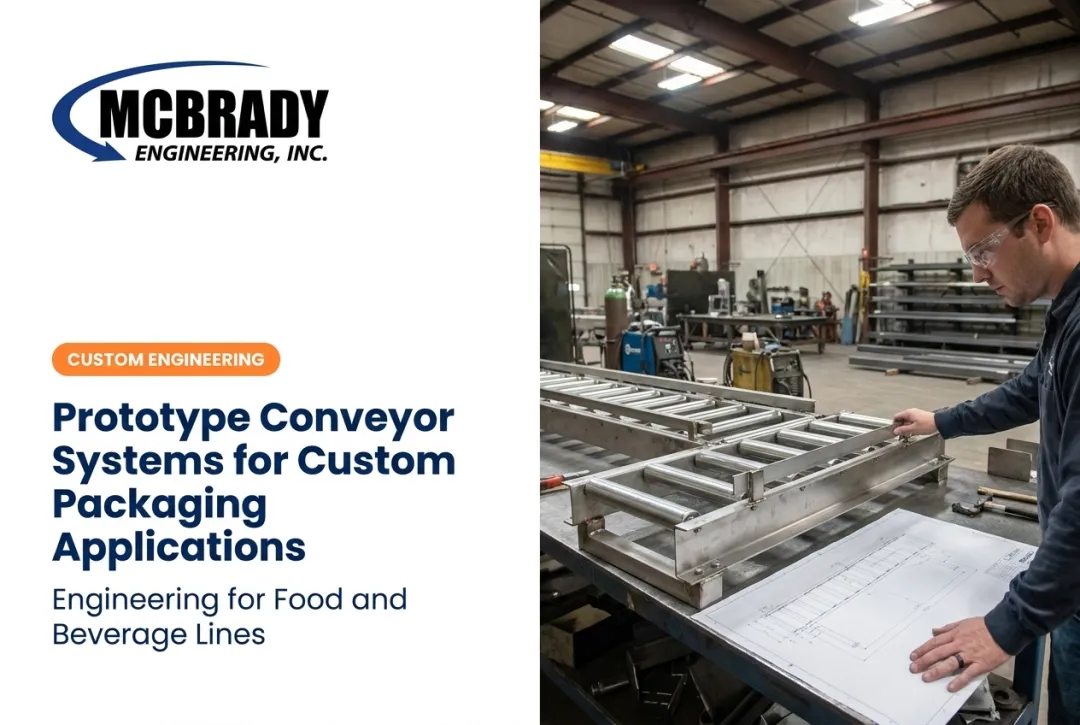
Specialized machinery often benefits from one partner connecting concept, fabrication, testing, and one-off or low-volume builds. McBrady Engineering, based in Joliet, Illinois, provides concept, design, fabrication, assembly, testing, and delivery for prototypes and one-off solutions. Its engineering covers 3D modeling, full-scale assembly drawings, finite element analysis, and 2D drawings.
Fabrication uses Type 304 and 316L stainless steel, mild steel, and approved plastics, with TIG welding and passivation on every weld. Pharmaceutical-grade welding is available on request.
This suits container-handling problems that catalog equipment can't solve, such as bottle-cleaning equipment for beverage, pharmaceutical, or chemical lines. Before a custom build starts, agree in writing on:
- Change-order handling and iteration costs
- Acceptance testing against your specification
- Documentation such as material certificates and weld and passivation records
Frequently Asked Questions
What is prototype development?
Prototype development is the creation and evaluation of an early product or system model before production. It often involves multiple iterations as test results shape each revision.
What are the stages of prototype development?
Typical stages are define requirements, research feasibility and concepts, build a proof of concept, build a functional prototype, test and iterate, then prepare the design for production.
What is a prototype example?
A 3D-printed housing tests fit and ergonomics. A working bottle-cleaning mechanism tests whether the cleaning action handles containers reliably.
What is the difference between a prototype and a proof of concept?
A proof of concept tests whether a core idea can work. A prototype is more developed and evaluates design, function, usability, and production needs.
How many prototypes are needed before production?
It varies with complexity and test results. Move forward when each version has answered its defined questions, not after a fixed count.
What is the difference between a prototype and an MVP?
A prototype validates design or engineering assumptions. An MVP is a limited usable product that tests market response with actual users.