
Many plants still wrestle with inconsistent manual processes, slow changeovers, and line bottlenecks that cap throughput. Contamination risk, tight floor space, and the challenge of connecting new equipment to older machinery add further friction.
This article breaks down the equipment categories behind packaging and manufacturing automation, the different automation types available, how it all works together on a line, and what to weigh before you buy. The focus is practical: what US manufacturing and packaging operations actually need to evaluate.
Key Takeaways
- Use machines, sensors, controllers, and software as process automation equipment to run repeatable production tasks
- Match fixed, programmable, flexible, discrete, process, batch, or hybrid automation to your volume and product mix
- Select equipment around line speed, container characteristics, changeover frequency, sanitation, safety, and integration needs
- Bottle-cleaning equipment readies containers for filling, labeling, or downstream handling on packaging lines
What Is Process Automation Equipment?
Process automation equipment is the physical machinery, sensors, and control systems that run production tasks with limited human input. It is not office workflow software or robotic process automation (RPA), which handle digital tasks like data entry rather than physical materials.
It also differs from discrete factory automation. According to ISA's description of factory automation and machine control:
- Discrete (factory) automation produces and assembles distinct items through machines or work cells
- Process automation monitors continuous variables such as flow, pressure, temperature, level, and speed
Three Levels of Automation Architecture
Most industrial automation systems are built in layers:
- Field level: Sensors, switches, actuators, motors, valves, and cylinders that detect conditions or move product
- Control level: PLCs, motion controllers, VFDs, and safety controllers that run programmed logic
- Supervisory level: HMIs, SCADA, and manufacturing software that monitor status, issue commands, and log data
These layers close the loop through feedback. A sensor flags a missing cap or low fill level; the controller compares that signal to setpoints, then adjusts the equipment or stops the line.
The right architecture depends on your mix of continuous materials, discrete batches, individual products, and packaging operations.

Types of Automation Equipment Used on Packaging and Manufacturing Lines
Instead of thinking of automation as one machine category, it helps to organize equipment by the task it performs on the line.
Conveying and container handling regulates product spacing and flow. Accumulation tables, feeders, indexing units, and conveyors keep containers moving at the right pace between stations without jamming or starving downstream equipment.
Primary packaging equipment varies by product and format, but commonly includes:
- Fillers and dosing systems
- Cappers and sealers
- Form-fill-seal machinery
- Case packers and cartoners
Inspection and quality-control equipment catches defects before they reach customers. This category includes:
- Vision systems and presence sensors
- Checkweighers and leak detection units
- Barcode readers
- Reject mechanisms that pull nonconforming units off the line automatically
Cleaning, Rinsing, and Preparation Equipment
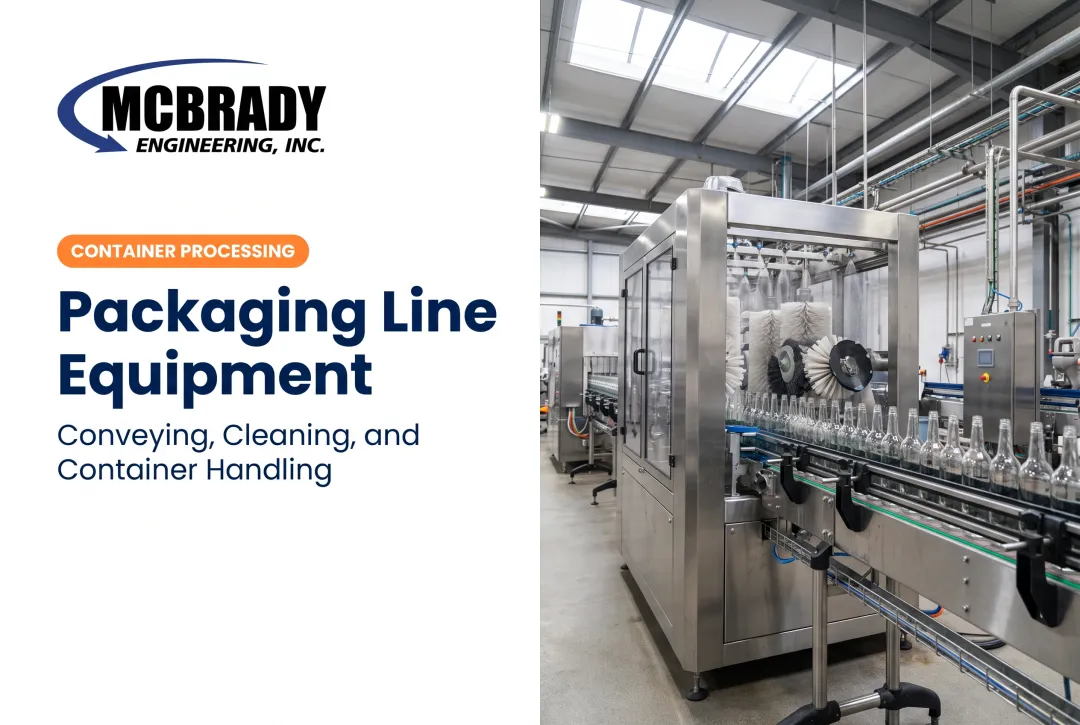
Before filling or labeling, containers often need cleaning, and interior and exterior requirements differ significantly. Interior cleaning removes residue, dust, or manufacturing debris from inside the container. Exterior cleaning addresses dust, labels, or handling residue on the outside.
McBrady Engineering builds compact interior and exterior bottle cleaners for food, beverage, pharmaceutical, and other container-cleaning applications. The Orbit Bottle Cleaner, for example, mounts over an existing conveyor and uses just 25 to 40 inches of line space, inverting and rinsing bottles via direct tube injection into the neck.
Gripper-style units like the HS-300 and HS-600 clean bottles from 1 ounce up to 1 gallon with no change parts required between sizes.
End-of-line equipment then takes over:
- Labelers, printers, and bundlers
- Case erectors, palletizers, and stretch wrappers
- Robotic material-handling systems
Supporting infrastructure includes compressed air systems, electrical panels, guarding, safety devices, washdown-compatible construction, and industrial communication networks that tie it all together.
How Automation Types Apply to Packaging and Manufacturing Lines
Not every line needs the same kind of automation. Control Engineering's analysis of flexible automation groups changeover capability into three practical categories.
Fixed automation is dedicated to repetitive production of one product or a limited assortment in large lots. It's efficient at scale but difficult to reconfigure when container formats or specifications change.
Programmable automation can be reprogrammed for a different operation, though it may still require manual tooling changes and downtime between runs. This suits batch production where recipes or sequences shift periodically.
Flexible automation combines recipe control with automated mechanical changeover, accommodating a wider product mix with less downtime. Software-controlled changeovers, adaptable tooling, and robotics fall into this category.
These three describe changeover capability. A separate set of terms describes production patterns:
| Type | What It Coordinates | Best-Fit Environment |
|---|---|---|
| Discrete | Individual products or containers through defined steps | Unit-based packaging lines |
| Process | Continuous or semi-continuous variables (flow, temperature, pressure) | Chemical, beverage base mixing |
| Batch | Recipes, stages, and records in sequence | Pharma, food formulation |
| Hybrid | Process stages feeding discrete packaging stages | Beverage bottling, filled-product lines |
No single type wins in every plant. Match the approach to production volume, product variety, compliance needs, and operational goals rather than the newest label on the market.
How Automation Equipment Works Together on a Production Line
A typical packaging line sequence moves like this: containers arrive, get cleaned, pass to filling, then closing, inspection, labeling, packing, and finally palletizing. Each stage depends on the one before it running correctly.

Sensors throughout the line detect container position, product level, cap presence, jams, speed, or quality conditions, then relay that data to the control system. The PLC or central controller coordinates timing, interlocks, recipes, and machine states so upstream and downstream equipment stay synchronized.
HMI and SCADA systems give operators visibility into alarms, set points, maintenance needs, and historical process data without a walk to every station.
Integration Requirements That Make or Break a Line
Connecting new equipment to an existing line involves more than bolting it into place:
- Mechanical handoffs between conveyors and machines need to match height, speed, and spacing
- Electrical and communication protocols must be compatible with existing controls
- Safety circuits, guarding, and emergency stops need to interlock across all equipment
- Testing and commissioning should verify cycle sequences, changeover procedures, reject logic, and data collection before full production runs
Legacy equipment and plant networks add complexity. Older PLCs may lack modern security features, so access control, network segmentation, and backup planning matter when you add new automation to an established plant.
That coordination shows up on the floor when a container-handling station joins the line. McBrady's 4-Belt Unscrambler/Single Filer uses four progressively moving belts to separate randomly oriented containers and convert them to single file, matched to conveyor speed downstream.
If that timing is off even briefly, bottles jam or skip the cleaning cycle and create quality problems further down the line.
Benefits and Applications of Process Automation Equipment
Automation's core value is repeatability. The same sequence, timing, pressure, fill level, or inspection criteria applies run after run, which manual processes struggle to match consistently.
Productivity gains follow from reduced manual handling and fewer bottlenecks.
In a Rockwell Automation case study of a food manufacturer, retrofitting safety diagnostics on two refrigerated-product case-packing lines produced 75% less average unplanned downtime, 50% less preventive-maintenance time, and more than $70,000 in annual ongoing savings. Those results came from one installation, not a universal benchmark, but they show what connected diagnostics can achieve.

Safety and ergonomics improve when automation absorbs repetitive motion, heavy lifting, fast-moving equipment, or hazardous residues, particularly in washdown environments where manual cleaning poses slip and chemical exposure risks.
Those same gains show up across container-handling lines. McBrady Engineering's equipment serves applications such as:
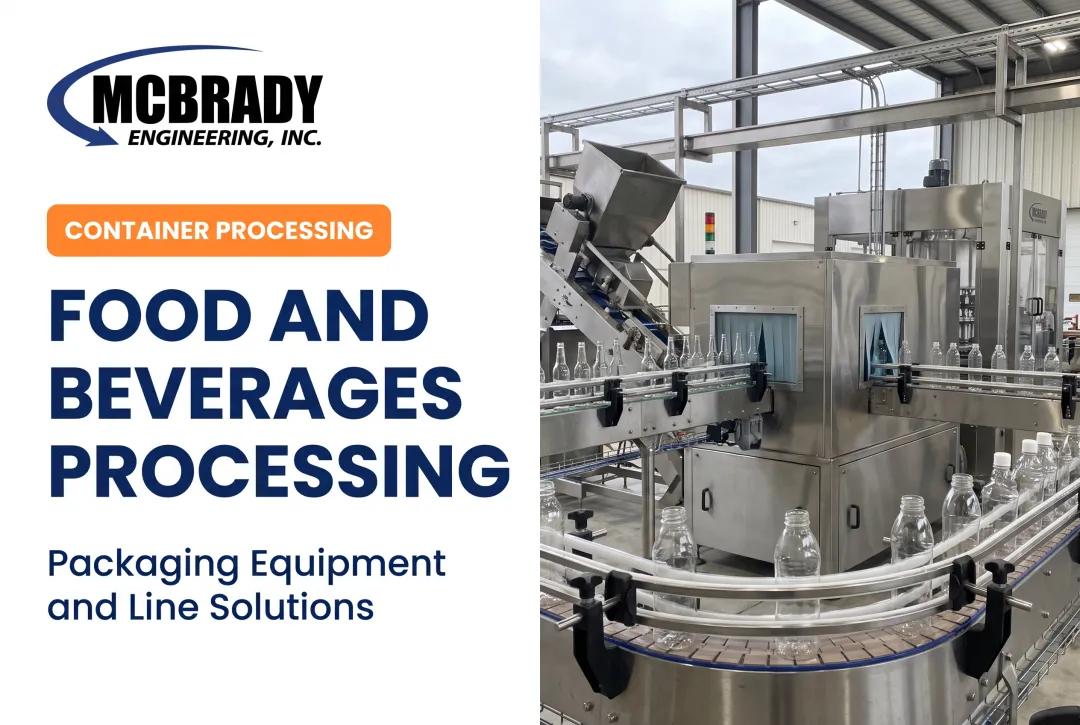
- Beverage bottling plants running high-speed lines
- Craft breweries, distilleries, and wineries on semi-automatic lines
- Pharmaceutical and nutraceutical vial and container fillers
- Chemical and household product packagers with aggressive residues
- Contract packagers handling multiple SKUs
Trade-Offs Worth Weighing
Automation still brings real trade-offs. Costs and complexity rise with more sophisticated systems:
- Higher capital cost, operator training, and maintenance skill needs
- Integration work and changeover limits on fixed equipment
- Ongoing cleaning and sanitation requirements
Plan for system support from day one, not after something breaks.
How to Choose and Integrate the Right Equipment
Start with a process audit. Capture the baseline before you shop:
- Line speed and container formats
- Manual steps and downtime causes
- Quality issues and cleaning requirements
- Available footprint and the outcomes you need
From there, specify requirements:
- Throughput targets
- Container dimensions and materials
- Changeover frequency and cleaning method
- Sanitation expectations
- Compatibility with existing conveyors and controls
Match automation type to the operation:
- Fixed automation for stable, high-volume production with minimal format changes
- Programmable or flexible automation for batches, frequent format changes, or high product variety
- Hybrid or integrated controls when process variables and discrete packaging steps need to work as one system
Evaluate safety and maintainability next. Guarding, emergency stops, accessible components, cleanable surfaces, corrosion resistance, and spare parts availability all affect long-term uptime.
Then confirm controls and support fit:
- PLC and HMI compatibility
- Communication protocols
- Training and documentation
- Remote support options
When Standard Equipment Doesn't Fit
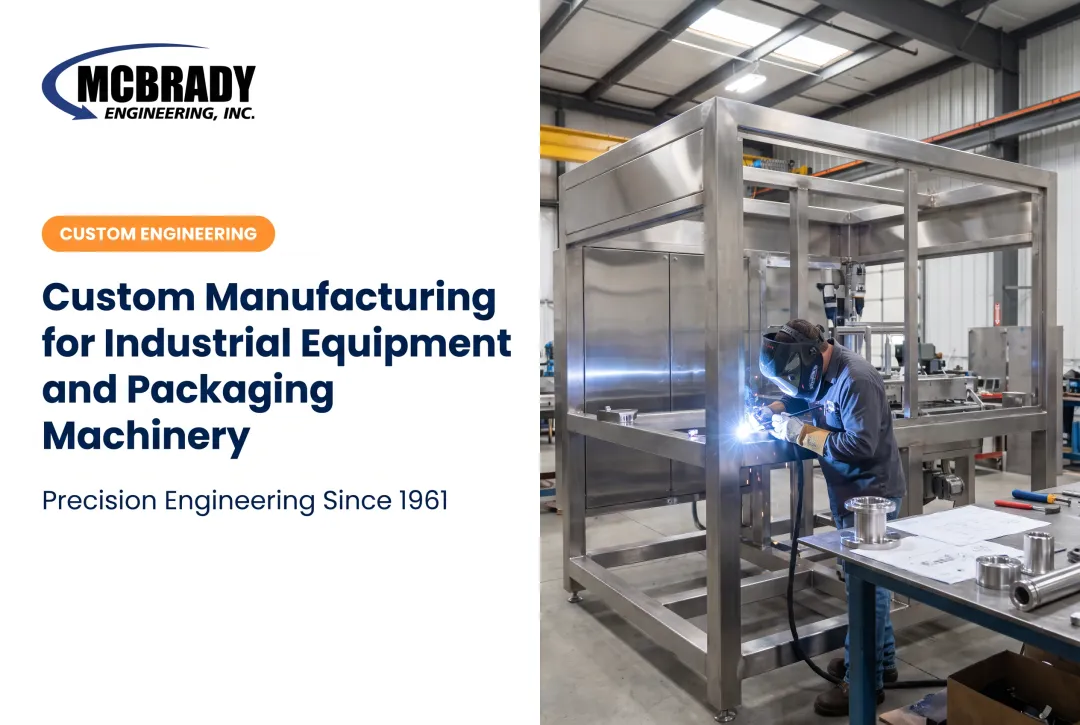
Sometimes a standard machine doesn't address an unusual container, a prototype, or a specialized line requirement. This is where custom engineering matters. McBrady Engineering's fabrication services support one-off and prototype bottle-cleaning solutions when off-the-shelf equipment falls short. Work typically runs through 3D modeling and finite element analysis, with stainless-steel TIG welding and passivation on every weld.
Whether you buy standard or custom, compare total cost of ownership—not just purchase price. Factor in:
- Installation, utilities, and tooling
- Changeover labor and maintenance
- Consumables and downtime risk over the equipment's working life
Pre-purchase checklist:
- Application data (container specs, speeds, product characteristics)
- Site conditions and available footprint
- Testing and acceptance criteria
- Integration scope with existing equipment
- Safety documentation and compliance needs
- Service and support expectations
Frequently Asked Questions
What are some common tools for workflow automation?
Business workflow tools automate digital tasks like approvals and data entry. Industrial automation equipment is different: it relies on PLCs, HMIs, SCADA systems, sensors, actuators, industrial networks, and machine-vision systems to run physical processes.
What is industrial automation equipment?
Industrial automation equipment includes the machines, control systems, sensors, software, and safety components used to perform or coordinate industrial tasks with limited manual intervention. This spans everything from conveyors to PLCs to vision inspection systems.
What are the four types of automation systems?
Classifications vary by source, but fixed, programmable, flexible, and integrated automation are commonly cited. Process, discrete, batch, and hybrid automation are also frequently used classifications, describing production patterns rather than changeover capability.